PI90LVB180
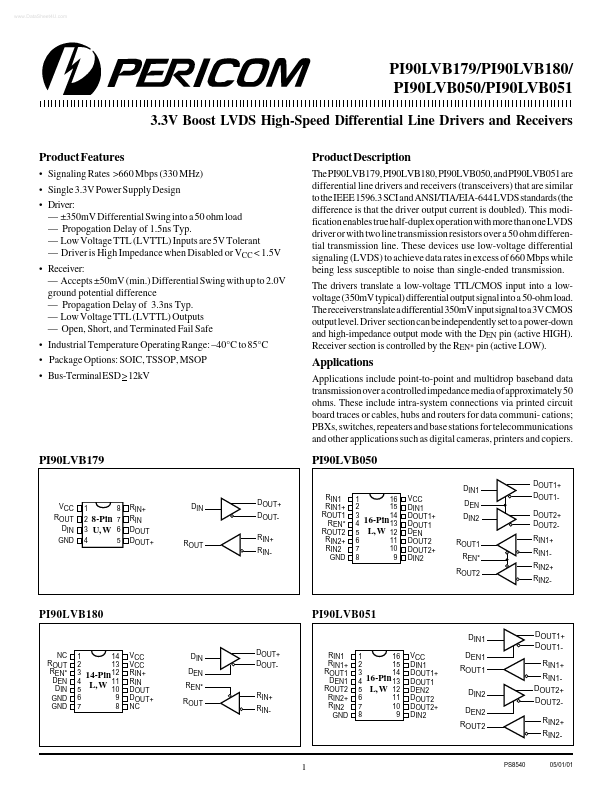
PI90LVB180 is (PI90LVBxxx) 3.3V Boost LVDS High-Speed Differential Line Drivers and Receivers manufactured by Pericom Semiconductor.
- Part of the PI90LVB050 comparator family.
- Part of the PI90LVB050 comparator family.
Features
- Signaling Rates >660 Mbps (330 MHz)
- Single 3.3V Power Supply Design
- Driver:
- ±350m V Differential Swing into a 50 ohm load
- Propogation Delay of 1.5ns Typ.
- Low Voltage TTL (LVTTL) Inputs are 5V Tolerant
- Driver is High Impedance when Disabled or VCC < 1.5V
- Receiver:
- Accepts ±50m V (min.) Differential Swing with up to 2.0V ground potential difference
- Propagation Delay of 3.3ns Typ.
- Low Voltage TTL (LVTTL) Outputs
- Open, Short, and Terminated Fail Safe
- Industrial Temperature Operating Range:
- 40°C to 85°C
- Package Options: SOIC, TSSOP, MSOP
- Bus-Terminal ESD > 12k V
Product Description
The PI90LVB179, PI90LVB180, PI90LVB050, and PI90LVB051 are differential line drivers and receivers (transceivers) that are similar to the IEEE 1596.3 SCI and ANSI/TIA/EIA-644 LVDS standards (the difference is that the driver output current is doubled). This modification enables true half-duplex operation with more than one LVDS driver or with two line transmission resistors over a 50 ohm differential transmission line. These devices use low-voltage differential signaling (LVDS) to achieve data rates in excess of 660 Mbps while being less susceptible to noise than single-ended transmission. The drivers translate a low-voltage TTL/CMOS input into a lowvoltage (350m V typical) differential output signal into a 50-ohm load. The receivers translate a differential 350m V input signal to a 3V CMOS output level. Driver section can be independently set to a power-down and high-impedance output mode with the DEN pin (active HIGH). Receiver section is controlled by the REN- pin (active LOW).
Applications
Applications include point-to-point and multidrop baseband data transmission over a controlled impedance media of approximately 50 ohms. These include intra-system connections via printed circuit board traces or cables, hubs and routers for data muni- cations; PBXs, switches, repeaters and base stations for telemunications and other applications such as digital...