TISP4380F3LM
TISP4380F3LM is BIDIRECTIONAL THYRISTOR OVERVOLTAGE PROTECTORS manufactured by Power Innovations Limited.
TISP4072F3LM, TISP4082F3LM, TISP4125F3LM, TISP4150F3LM, TISP4180F3LM TISP4240F3LM, TISP4260F3LM, TISP4290F3LM, TISP4320F3LM, TISP4380F3LM BIDIRECTIONAL THYRISTOR OVERVOLTAGE PROTECTORS
Copyright © 1999, Power Innovations Limited, UK DECEMBER 1998
- REVISED APRIL 1999
TELEMUNICATION SYSTEM SECONDARY PROTECTION q
Ion-Implanted Breakdown Region Precise and Stable Voltage Low Voltage Overshoot under Surge
DEVICE ‘4072 ‘4082 ‘4125 ‘4150 ‘4180 ‘4240 ‘4260 ‘4290 ‘4320 ‘4380 VDRM V 58 66 100 120 145 180 200 220 240 270 V(BO) V 72 82 125 150 180 240 260 290 320 380
LM PACKAGE (TOP VIEW)
T(A) NC R(B)
1 2 3
MD4XAT
- No internal connection on pin 2 LMF PACKAGE (LM PACKAGE WITH FORMED LEADS) (TOP VIEW)
T(A) NC R(B)
1 2 3
MD4XAKB
- No internal connection on pin 2 q
Rated for International Surge Wave Shapes
WAVE SHAPE 10/160 µs 0.5/700 µs 10/700 µs 10/560 µs 10/1000 µs STANDARD FCC Part 68 I3124 ITU-T K20/21 FCC Part 68 REA PE-60 ITSP A 60 38 50 45 35 R PACKAGE TYPE Straight Lead DO-92 Bulk Pack Straight Lead DO-92 Tape and Reeled
SD4XAA device symbol
T q
Ordering Information
DEVICE TYPE TISP4xxx F3LM TISP4xxx F3LMR
Terminals T and R correspond to the alternative line designators of A and B
TISP4xxx F3LMFR Formed Lead DO-92 Tape and Reeled description
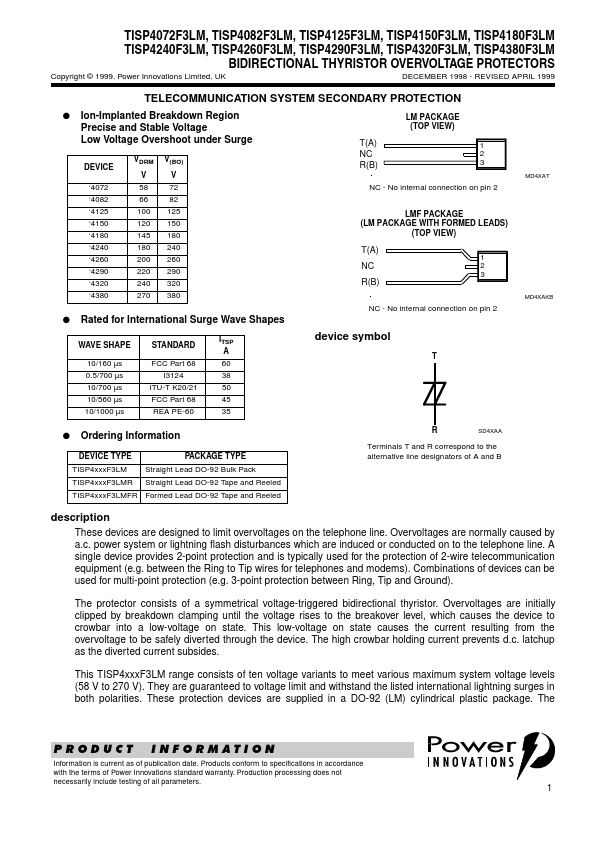
These devices are designed to limit overvoltages on the telephone line. Overvoltages are normally caused by a.c. power system or lightning flash disturbances which are induced or conducted on to the telephone line. A single device provides 2-point protection and is typically used for the protection of 2-wire telemunication equipment (e.g. between the Ring to Tip wires for telephones and modems). binations of devices can be used for multi-point protection (e.g. 3-point protection between Ring, Tip and Ground). The protector consists of a symmetrical voltage-triggered bidirectional thyristor. Overvoltages are initially clipped by breakdown clamping until the voltage rises to the breakover level, which...