FM24V10
FM24V10 is 3V F-RAM Memory manufactured by Ramtron.
.Data Sheet.co.kr
Pre-Production
1Mb Serial 3V F-RAM Memory Features
1M bit Ferroelectric Nonvolatile RAM
- Organized as 131,072 x 8 bits
- High Endurance 100 Trillion (1014) Read/Writes
- 10 year Data Retention
- No Delay™ Writes
- Advanced High-Reliability Ferroelectric Process Fast Two-wire Serial Interface
- Up to 3.4 MHz maximum bus frequency
- Direct hardware replacement for EEPROM
- Supports legacy timing for 100 k Hz & 400 k Hz Device ID and Serial Number
- Device ID reads out Manufacturer ID & Part ID
- Unique Serial Number (FM24VN10) Low Voltage, Low Power Operation
- Low Voltage Operation 2.0V
- 3.6V
- Active Current < 150 µA (typ. @ 100KHz)
- 90 µA Standby Current (typ.)
- 5 µA Sleep Mode Current (typ.) Industry Standard Configuration
- Industrial Temperature -40° C to +85° C
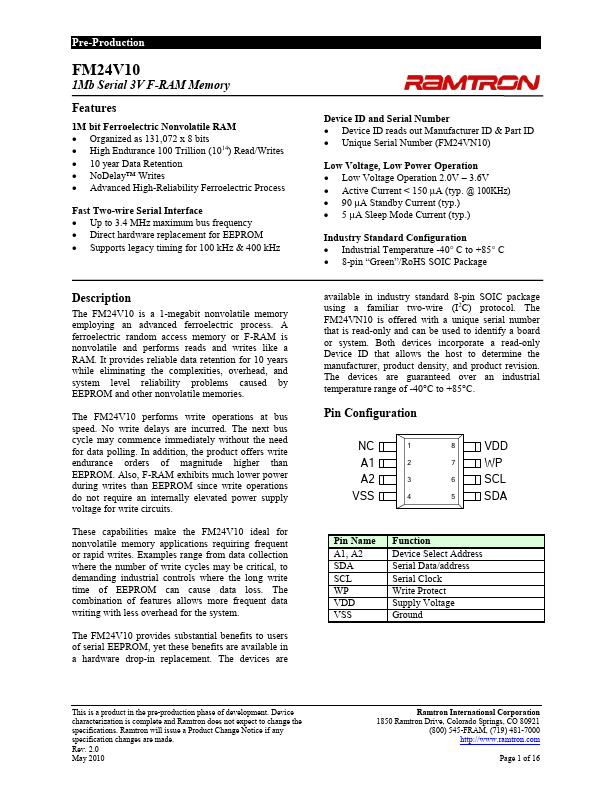
- 8-pin “Green”/Ro HS SOIC Package available in industry standard 8-pin SOIC package using a familiar two-wire (I2C) protocol. The FM24VN10 is offered with a unique serial number that is read-only and can be used to identify a board or system. Both devices incorporate a read-only Device ID that allows the host to determine the manufacturer, product density, and product revision. The devices are guaranteed over an industrial temperature range of -40°C to +85°C.
Description
The FM24V10 is a 1-megabit nonvolatile memory employing an advanced ferroelectric process. A ferroelectric random access memory or F-RAM is nonvolatile and performs reads and writes like a RAM. It provides reliable data retention for 10 years while eliminating the plexities, overhead, and system level reliability problems caused by EEPROM and other nonvolatile memories. The FM24V10 performs write operations at bus speed. No write delays are incurred. The next bus cycle may mence immediately without the need for data polling. In addition, the product offers write endurance orders of magnitude higher than EEPROM. Also, F-RAM exhibits much lower power during writes than EEPROM since write operations...