

Overview: DATASHEET HIP9011
Engine Knock Signal Processor FN4367 Rev 2.00 January 6, 2006 The HIP9011 is used to provide a method of detecting premature detonation often referred to as “Knock or Ping” in internal bustion engines.
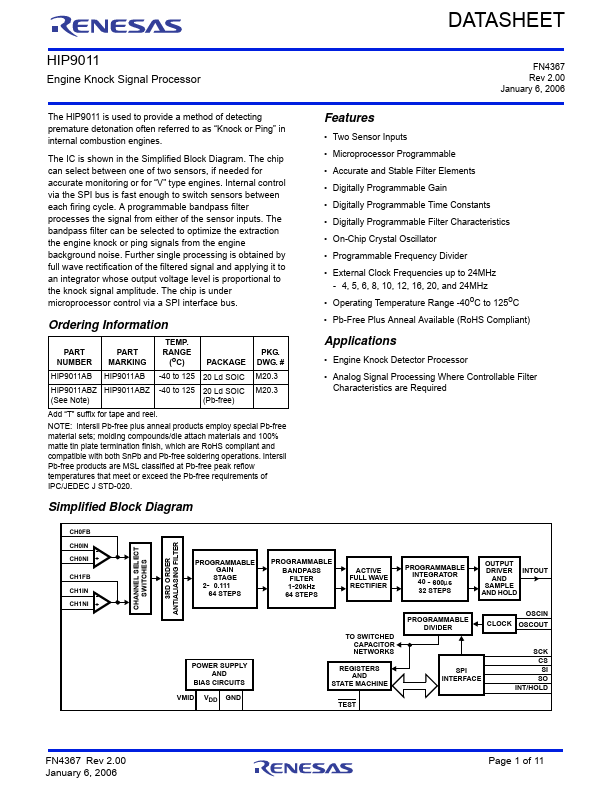
The IC is shown in the Simplified Block Diagram. The chip can select between one of two sensors, if needed for accurate monitoring or for “V” type engines. Internal control via the SPI bus is fast enough to switch sensors between each firing cycle. A programmable bandpass filter processes the signal from either of the sensor inputs. The bandpass filter can be selected to optimize the extraction the engine knock or ping signals from the engine background noise. Further single processing is obtained by full wave rectification of the filtered signal and applying it to an integrator whose output voltage level is proportional to the knock signal amplitude. The chip is under microprocessor control via a SPI interface bus. Ordering Information PART NUMBER PART MARKING TEMP. RANGE
(oC) PKG. PACKAGE DWG. # HIP9011AB HIP9011AB -40 to 125 20 Ld SOIC M20.3 HIP9011ABZ HIP9011ABZ -40 to 125 20 Ld SOIC M20.3 (See Note) (Pb-free) Add “T” suffix for tape and reel.
NOTE: Intersil Pb-free plus anneal products employ special Pb-free material sets; molding pounds/die attach materials and 100% matte tin plate termination finish, which are RoHS pliant and patible with both SnPb and Pb-free soldering operations. Intersil Pb-free products are MSL classified at Pb-free peak reflow temperatures that meet or exceed the Pb-free requirements of IPC/JEDEC J STD-020.