Datasheet4U Logo Datasheet4U.com

IDTF1951NBGI8 - Digital Step Attenuator

Download the IDTF1951NBGI8 datasheet PDF. This datasheet also covers the IDTF1951 variant, as both devices belong to the same digital step attenuator family and are provided as variant models within a single manufacturer datasheet.

General Description

This document describes the specification for the F1951 Digital Step Attenuator.

The F1951 is part of a family of Glitch-FreeTM DSAs optimized for the demanding requirements of communications Infrastructure.

Key Features

  • Glitch-FreeTM, < 0.6 dB transient overshoot.
  • Spurious Free Design.
  • 3 V to 5.25 V supply.
  • Attenuation Error < 0.2 dB @ 2 GHz.
  • Low Insertion Loss < 1.2 dB @ 2 GHz.
  • Excellent Linearity +65 dBm IP3I.
  • Fast settling time, < 450 ns.
  • Class 2 JEDEC ESD (> 2kV HBM).
  • Serial Interface 31.5 dB Range.
  • Stable Integral Non-Linearity over temperature.
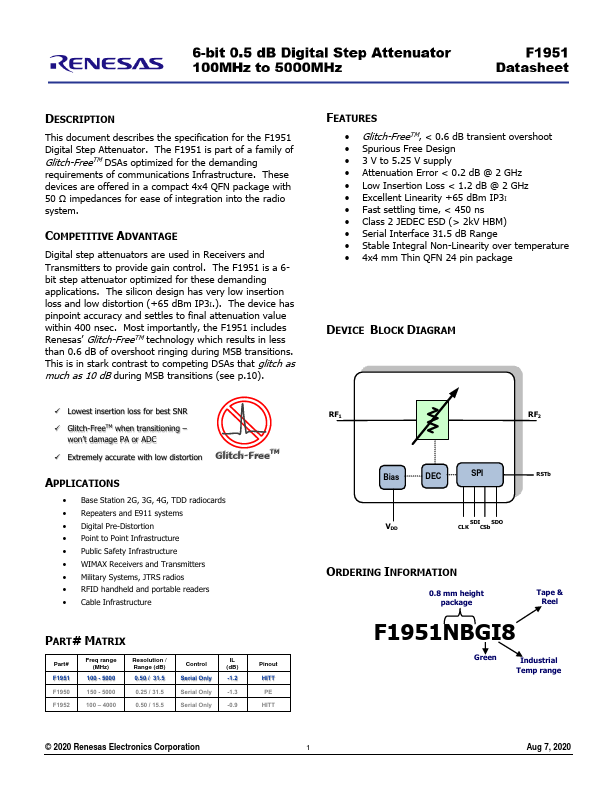
  • 4x4 mm Thin QFN 24 pin package DEVICE BLOCK.

📥 Download Datasheet

Note: The manufacturer provides a single datasheet file (IDTF1951-Renesas.pdf) that lists specifications for multiple related part numbers.

Full PDF Text Transcription (Reference)

The following content is an automatically extracted verbatim text from the original manufacturer datasheet and is provided for reference purposes only.

View original datasheet text
DESCRIPTION This document describes the specification for the F1951 Digital Step Attenuator. The F1951 is part of a family of Glitch-FreeTM DSAs optimized for the demanding requirements of communications Infrastructure. These devices are offered in a compact 4x4 QFN package with 50 Ω impedances for ease of integration into the radio system. COMPETITIVE ADVANTAGE Digital step attenuators are used in Receivers and Transmitters to provide gain control. The F1951 is a 6bit step attenuator optimized for these demanding applications. The silicon design has very low insertion loss and low distortion (+65 dBm IP3I.). The device has pinpoint accuracy and settles to final attenuation value within 400 nsec.