X9420
X9420 is Low Noise/Low Power/SPI Bus Single Digitally Controlled XDCP Potentiometer manufactured by Renesas.
NOT REMENDED FOR NEW DESIGNS POSSIBLE SUBSTITUTE PRODUCT
ISL22416, ISL22419, ISL95311, ISL95711
Low Noise/Low Power/SPI Bus Single Digitally Controlled (XDCP™) Potentiometer
FN8195 Rev.1.00 April 26, 2006
Features
- Solid-State Potentiometer
- SPI Serial Interface
- Register Oriented Format
- Direct read/write/transfer wiper positions
- Store as many as four positions per potentiometer
- Power Supplies
- VCC = 2.7V to 5.5V
- V+ = 2.7V to 5.5V
- V- = -2.7V to -5.5V
- Low Power CMOS
- Standby current < 1µA
- High Reliability
- Endurance- 100,000 data changes per bit per register
- Register data retention- 100 years
- 8-bytes of Nonvolatile EEPROM Memory
- 10k or 2.5k Resistor Arrays
- Resolution: 64 Taps Each Pot
- 14 Ld TSSOP and 16 Ld SOIC Packages
- Pb-Free Plus Anneal Available (Ro HS pliant)
DESCRIPTION
The X9420 integrates a single digitally controlled potentiometers (XDCP) on a monolithic CMOS integrated microcircuit.
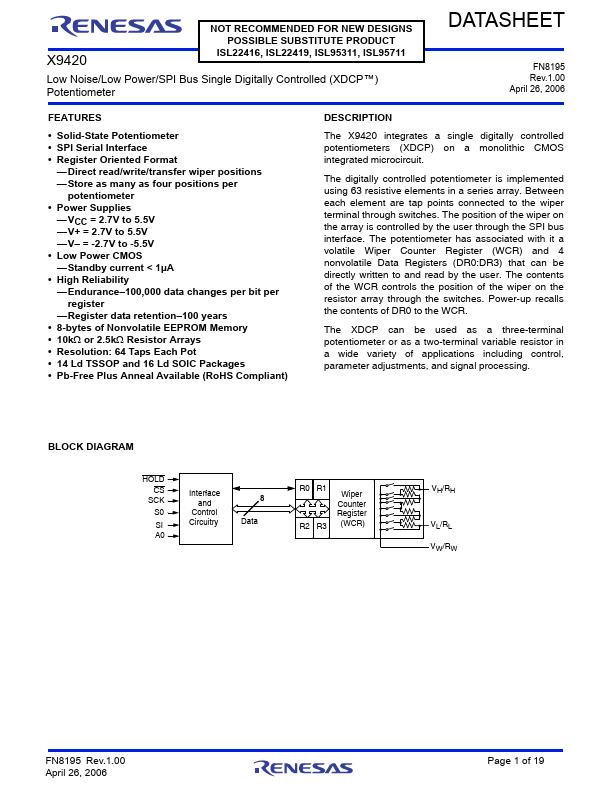
The digitally controlled potentiometer is implemented using 63 resistive elements in a series array. Between each element are tap points connected to the wiper terminal through switches. The position of the wiper on the array is controlled by the user through the SPI bus interface. The potentiometer has associated with it a volatile Wiper Counter Register (WCR) and 4 nonvolatile Data Registers (DR0:DR3) that can be directly written to and read by the user. The contents of the WCR controls the position of the wiper on the resistor array through the switches. Power-up recalls the contents of DR0 to the WCR.
The XDCP can be used as a three-terminal potentiometer or as a two-terminal variable resistor in a wide variety of applications including control, parameter adjustments, and signal processing.
BLOCK DIAGRAM
HOLD...