• Part: BA6826FS
  • Description: 2-phase motor driver for VCR cylinder motors
  • Manufacturer: ROHM
  • Size: 103.19 KB
Download BA6826FS Datasheet PDF
ROHM
BA6826FS
BA6826FS is 2-phase motor driver for VCR cylinder motors manufactured by ROHM.
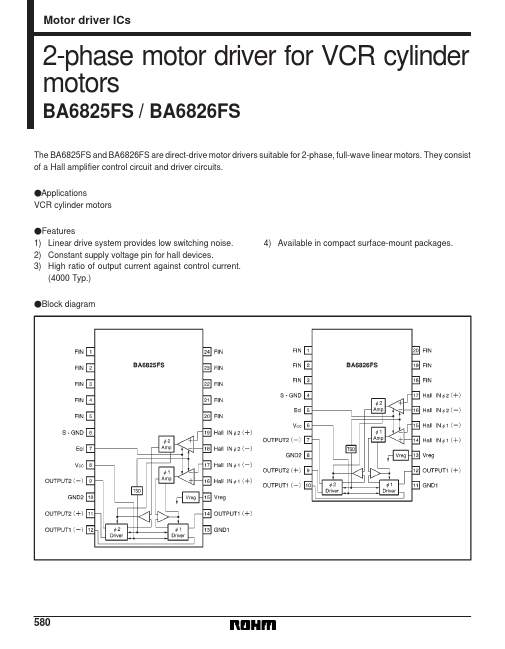
Motor driver ICs 2-phase motor driver for VCR cylinder motors BA6825FS / BA6826FS The BA6825FS and BA6826FS are direct-drive motor drivers suitable for 2-phase, full-wave linear motors. They consist of a Hall amplifier control circuit and driver circuits. FApplications VCR cylinder motors FFeatures 1) Linear drive system provides low switching noise. 2) Constant supply voltage pin for hall devices. 3) High ratio of output current against control current. (4000 Typ.) FBlock diagram 4) Available in pact surface-mount packages. Motor driver ICs FAbsolute maximum ratings (Ta = 25_C) BA6825FS / BA6826FS FRemended operating conditions FElectrical characteristics (unless otherwise noted, Ta = 25_C, VCC = 12V) FPin descriptions Motor driver ICs FInput / output circuits (1) Hall and ECI inputs BA6825FS / BA6826FS (2) Coil output FCircuit operation (1) The signal from the Hall device is amplified by the Hall amplifier and then supplied to the driver circuit. The driver gain, which is constant, is regulated by changing the Hall amplifier gain with the input current on the output current control pin (ECI pin). The motor rotational speed is sensed by the FG, and the output of which is F / I-converted and supplied to the ECI pin as a feedback signal, so that a constant rotational speed is maintained as follows : (1) The motor speed decreases. (2) The speed control IC outputs a feedback signal to the ECI pin. (3) The Hall amplifier gain increases. (4) The output current increases. (5) The motor speed increases. (2) When the voltage on Hall INφ1 ()) is higher than the voltage on Hall INφ1 (- ), an output current flows from OUT1 (- ) to OUT1 ()) according to the voltage differential. When the voltage on Hall INφ1 (- ) is higher, on the other hand, an output current flows from OUT1 ()) to OUT1 (- ). Similarly, when the voltage on Hall INφ2 ()) is higher than the voltage on Hall INφ2 (- ), an output current flows from OUT2 (- ) to OUT2 ()) according to the voltage...