Datasheet4U Logo Datasheet4U.com

ST763ACDTR - 3.3V STEP DOWN CURRENT MODE PWM DC-DC CONVERTERS

This page provides the datasheet information for the ST763ACDTR, a member of the ST763A 3.3V STEP DOWN CURRENT MODE PWM DC-DC CONVERTERS family.

Description

The ST763A is a step-down switching regulator .

It operates from 3.3V to 11V giving a fixed 3.3V output voltage, delivering up to 500mA.

Features

  • are typical efficiency of 90%, quiescent current of 0.6mA, and only 0.2µA in shut-down. The PWM current mode control provides precise output regulation and very good transient response. Output voltage accuracy is guaranteed to be ±5% over line, load and temperature variations. A minimum number of external components is used and the fixed frequency switching allows easy filtering of output ripple and noise. Other features of this ddevice are cycle-by-clicle current limiting, overcurrent limiting.

📥 Download Datasheet

Datasheet preview – ST763ACDTR

Datasheet Details

Part number ST763ACDTR
Manufacturer STMicroelectronics
File Size 250.51 KB
Description 3.3V STEP DOWN CURRENT MODE PWM DC-DC CONVERTERS
Datasheet download datasheet ST763ACDTR Datasheet
Additional preview pages of the ST763ACDTR datasheet.
Other Datasheets by STMicroelectronics

Full PDF Text Transcription

Click to expand full text
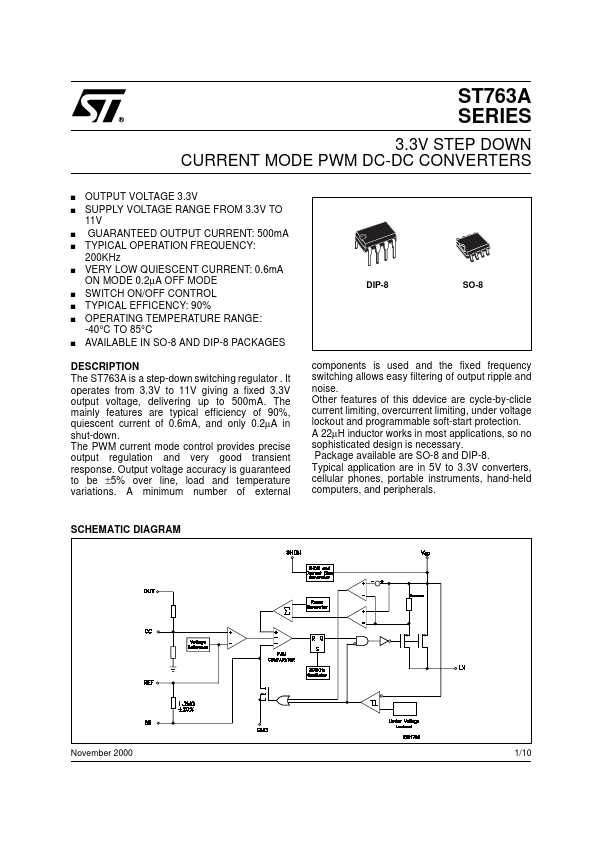
ST763A SERIES 3.3V STEP DOWN CURRENT MODE PWM DC-DC CONVERTERS s s s s s s s s s OUTPUT VOLTAGE 3.3V SUPPLY VOLTAGE RANGE FROM 3.3V TO 11V GUARANTEED OUTPUT CURRENT: 500mA TYPICAL OPERATION FREQUENCY: 200KHz VERY LOW QUIESCENT CURRENT: 0.6mA ON MODE 0.2µA OFF MODE SWITCH ON/OFF CONTROL TYPICAL EFFICENCY: 90% OPERATING TEMPERATURE RANGE: -40°C TO 85°C AVAILABLE IN SO-8 AND DIP-8 PACKAGES DIP-8 SO-8 DESCRIPTION The ST763A is a step-down switching regulator . It operates from 3.3V to 11V giving a fixed 3.3V output voltage, delivering up to 500mA. The mainly features are typical efficiency of 90%, quiescent current of 0.6mA, and only 0.2µA in shut-down. The PWM current mode control provides precise output regulation and very good transient response.
Published: |