Datasheet4U Logo Datasheet4U.com

SC1205H - High Speed Syncronous Power MOSFET Driver

General Description

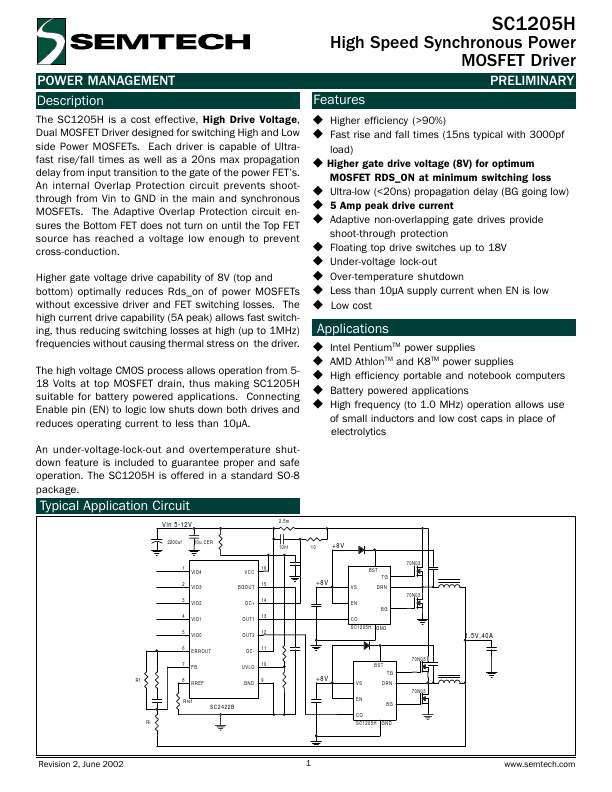
The SC1205H is a cost effective, High Drive Voltage, Dual MOS.ET Driver designed for switching High and Low side Power MOS.ETs.

Each driver is capable of Ultrafast rise/fall times as well as a 20ns max propagation delay from input transition to the gate of the power .ET’s.

Key Features

  • that allow fast switching and low propagation delays. . ast Switching Drives As the switching frequency of PWM controllers is increased to reduce power supply volume and cost, fast rise and fall times are necessary to minimize switching losses (TOP MOS. ET) and reduce dead-time (BOTTOM MOS. ET) losses. While low Rds_On MOS. ET’s present a power saving in I2R losses, the MOS. ETs die area is larger and the effective input capacitance of the MOS. ET is increased. Often a 50% decrease in Rds_On doubles t.

📥 Download Datasheet

Datasheet Details

Part number SC1205H
Manufacturer SEMTECH
File Size 224.73 KB
Description High Speed Syncronous Power MOSFET Driver
Datasheet download datasheet SC1205H Datasheet

Full PDF Text Transcription (Reference)

The following content is an automatically extracted verbatim text from the original manufacturer datasheet and is provided for reference purposes only.

View original datasheet text
POWER MANAGEMENT Description The SC1205H is a cost effective, High Drive Voltage, Dual MOS.ET Driver designed for switching High and Low side Power MOS.ETs. Each driver is capable of Ultrafast rise/fall times as well as a 20ns max propagation delay from input transition to the gate of the power .ET’s. An internal Overlap Protection circuit prevents shootthrough from Vin to GND in the main and synchronous MOS.ETs. The Adaptive Overlap Protection circuit ensures the Bottom .ET does not turn on until the Top .ET source has reached a voltage low enough to prevent cross-conduction. Higher gate voltage drive capability of 8V (top and bottom) optimally reduces Rds_on of power MOS.ETs without excessive driver and .ET switching losses.