SX1701A
SX1701A is single-ended to differential conversion manufactured by SEMTECH.
SCRIPTION
The SX1701A is an integrated LNA operating over a wide frequency range from 40 MHz to 2.5 GHz. It is optimized for high OIP2 and OIP3 with minimum current consumption. It also performs a single-ended to differential conversion with 3 selectable gains.
KEY PRODUCT Features
- -
- -
- -
- -
- Single-ended input / Differential outputs Programmable gain: 6, 12 and 18 d B High Linearity: OIP2 of 57 d Bm and OIP3 of 22 d Bm Noise Figure of 7 d B 75 Ω Input impedance 100 Ω differential output impedance Current consumption of 130 m A at maximum gain ESD protection (Normal ESD handling procedures should be observed) Very small package: MLPQ-16, 4 mm x 4 mm (equivalent to QFN-16, 4 mm x 4 mm)
APPLICATIONS
- -
- -
- Digital Set Top Boxes (Satellite and Terrestrial) CATV Distribution Systems Active Splitter Data munications Systems Active Balun
ORDERING INFORMATION
Part number Temperature range Package
Lead Free MLPQ-16 Note: This device is WEEE and Ro HS pliant. SX1701AI085TRT -40 °C to +85 °C
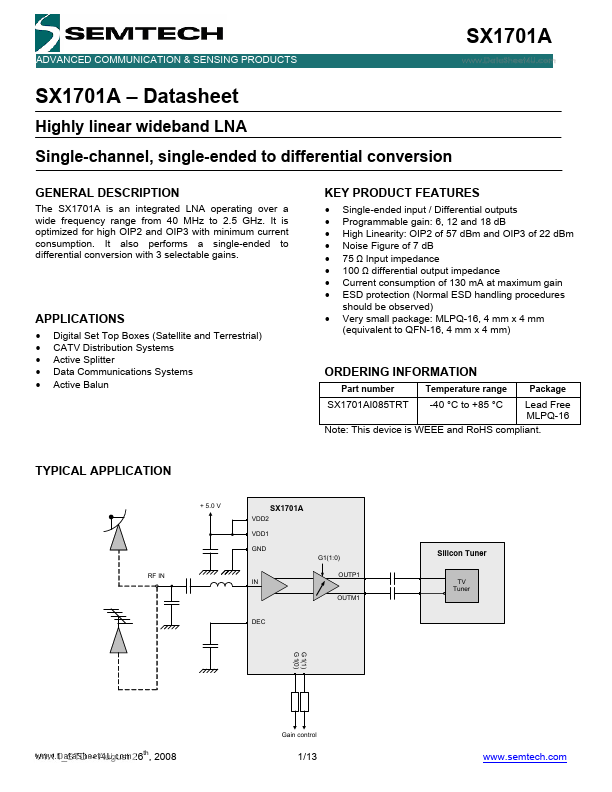
TYPICAL APPLICATION
+ 5.0 V VDD2 VDD1 GND G1(1:0) RF IN OUTP1 IN OUTM1
Silicon Tuner
TV Tuner
Gain control
G1(1) G1(0)
V1.11_STD
- August 26th, 2008
1/13
.semtech.
ADVANCED MUNICATION & SENSING PRODUCTS
.. Datasheet
TABLE OF CONTENTS
1 2 2.1.1 2.1.2 3 3.1 3.2 3.2.1 3.2.2 3.3 4 5 5.1 6 7 8 Simplified Block Diagram..............................................................................................................................3 Pin Description...............................................................................................................................................4 Pin Connections...............................................................................................................................................4 Gain Control Pins.............................................................................................................................................4 Electrical Characteristics...