

Datasheet4U Logo Datasheet4U.com

GP2W0002YP - Low Power Infrared Transceiver

Datasheet Summary

Description

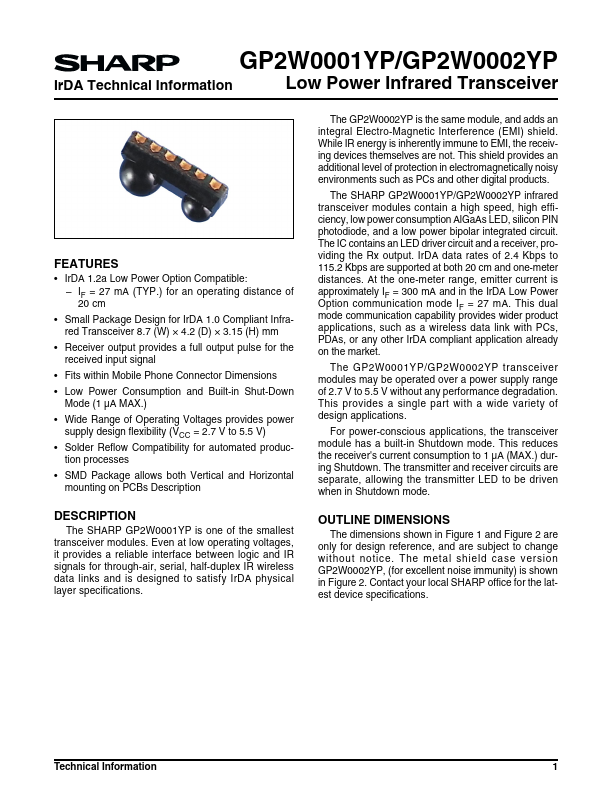
The SHARP GP2W0001YP is one of the smallest transceiver modules.

Even at low operating voltages, it provides a reliable interface between logic and IR signals for through-air, serial, half-duplex IR wireless data links and is designed to satisfy IrDA physical layer specifications.

Features

  • IrDA 1.2a Low Power Option Compatible:.
  • IF = 27 mA (TYP. ) for an operating distance of 20 cm.
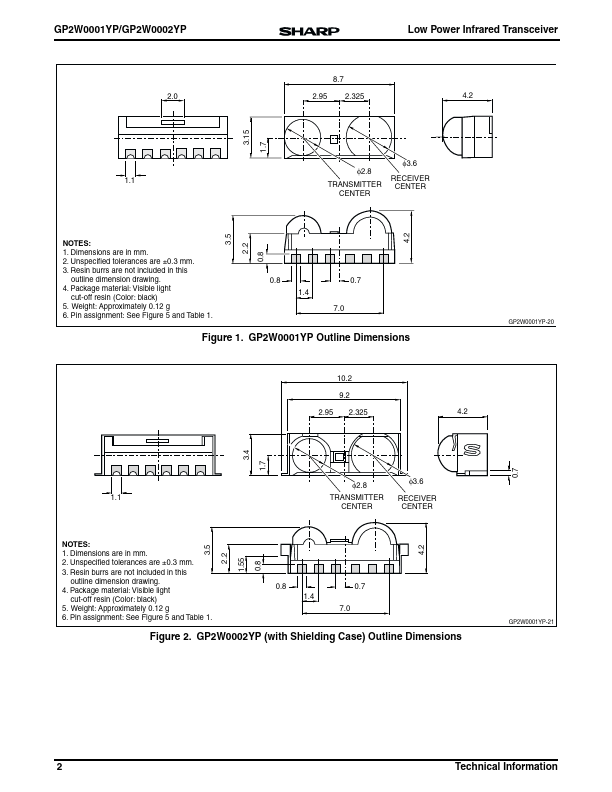
  • Small Package Design for IrDA 1.0 Compliant Infrared Transceiver 8.7 (W) × 4.2 (D) × 3.15 (H) mm.
  • Receiver output provides a full output pulse for the received input signal.
  • Fits within Mobile Phone Connector Dimensions.
  • Low Power Consumption and Built-in Shut-Down Mode (1 µA MAX. ).
  • Wide Range of Operating Voltages provides power supply des.

📥 Download Datasheet

Datasheet preview – GP2W0002YP

Datasheet Details

Part number GP2W0002YP
Manufacturer Sharp Electrionic Components
File Size 145.90 KB
Description Low Power Infrared Transceiver
Datasheet download datasheet GP2W0002YP Datasheet
Additional preview pages of the GP2W0002YP datasheet.
Other Datasheets by Sharp Electrionic Components

Full PDF Text Transcription

Click to expand full text
GP2W0001YP/GP2W0002YP IrDA Technical Information Low Power Infrared Transceiver The GP2W0002YP is the same module, and adds an integral Electro-Magnetic Interference (EMI) shield. While IR energy is inherently immune to EMI, the receiving devices themselves are not. This shield provides an additional level of protection in electromagnetically noisy environments such as PCs and other digital products. The SHARP GP2W0001YP/GP2W0002YP infrared transceiver modules contain a high speed, high efficiency, low power consumption AlGaAs LED, silicon PIN photodiode, and a low power bipolar integrated circuit. The IC contains an LED driver circuit and a receiver, providing the Rx output. IrDA data rates of 2.4 Kbps to 115.2 Kbps are supported at both 20 cm and one-meter distances.
Published: |