• Part: CL1A
  • Description: Unipolar Current Regulator
  • Category: Voltage Regulator
  • Manufacturer: SimpleChips
  • Size: 402.33 KB
Download CL1A Datasheet PDF
SimpleChips
CL1A
CL1A is Unipolar Current Regulator manufactured by SimpleChips.
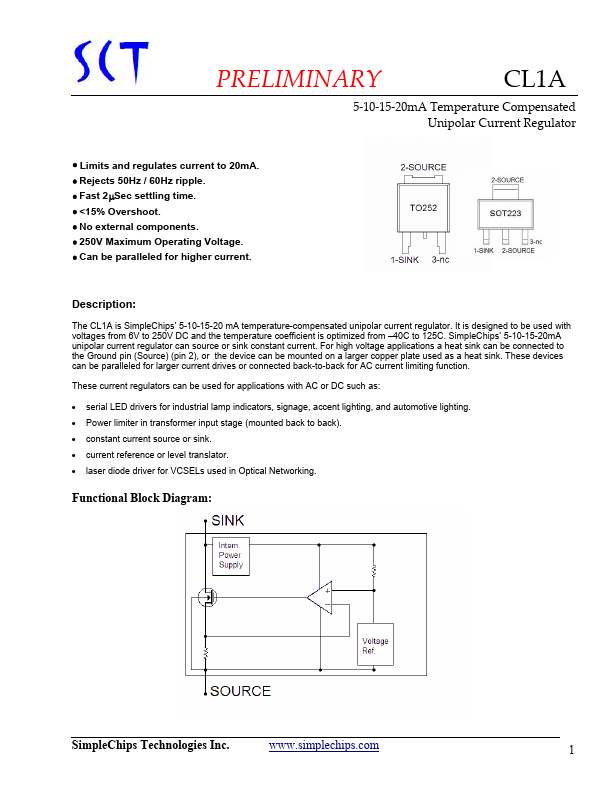
Description : The CL1A is Simple Chips’ 5-10-15-20 m A temperature-pensated unipolar current regulator. It is designed to be used with voltages from 6V to 250V DC and the temperature coefficient is optimized from - 40C to 125C. Simple Chips’ 5-10-15-20m A unipolar current regulator can source or sink constant current. For high voltage applications a heat sink can be connected to the Ground pin (Source) (pin 2), or the device can be mounted on a larger copper plate used as a heat sink. These devices can be paralleled for larger current drives or connected back-to-back for AC current limiting function. These current regulators can be used for applications with AC or DC such as: - serial LED drivers for industrial lamp indicators, signage, accent lighting, and automotive lighting. - Power limiter in transformer input stage (mounted back to back). - constant current source or sink. - current reference or level translator. - laser diode driver for VCSELs used in Optical Networking. Functional Block Diagram: Simple Chips Technologies Inc. .simplechips. Terminal Functions: Terminal SC_CL1A Name pin no. Sink Source PRELIMINARY 5-10-15-20m A Temperature pensated Unipolar Current Regulator Type HV Input VH input Description Sinks load current Usually Grounded. All voltages referenced to source. Sources load current Absolute Maximum Ratings: Maximum Operating Voltage (see Note 1) ……………………... 250 Volts DC Operating free air temperature range …………………………... -40 degree C to 85 degree C Storage temperature ………………………………………………. -40 degree C to 85 degree C ESD tolerance, human body model ……………………………… 500 Volts Stresses beyond those listed under “absolute maximum ratings” may cause permanent damage to the device. These are stress ratings only, and functional operation of the device at these or any other conditions beyond those indicated under “Remended Operating Conditions” is not implied. Exposure to absolute-maximum-rated conditions for extended period may affect...