Datasheet4U Logo Datasheet4U.com

SGA-1163 - DC-6000 Mhz Silicon Germanium HBT Cascadeable Gain Block

Download the SGA-1163 datasheet PDF. This datasheet also covers the SGA1163 variant, as both devices belong to the same dc-6000 mhz silicon germanium hbt cascadeable gain block family and are provided as variant models within a single manufacturer datasheet.

General Description

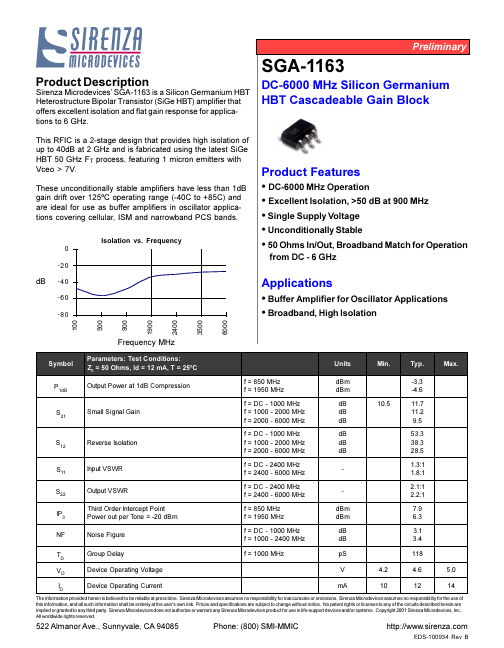
Sirenza Microdevices’ SGA-1163 is a Silicon Germanium HBT Heterostructure Bipolar Transistor (SiGe HBT) amplifier that offers excellent isolation and flat gain response for applications to 6 GHz.

Key Features

  • • DC-6000 MHz Operation • Excellent Isolation, >50 dB at 900 MHz • Single Supply Voltage • Unconditionally Stable • 50 Ohms In/Out, Broadband Match for Operation from DC - 6 GHz dB -40 -60 -80 100 500 900 1900 2400 3500 6000.

📥 Download Datasheet

Note: The manufacturer provides a single datasheet file (SGA1163_SirenzaMicrodevices.pdf) that lists specifications for multiple related part numbers.

Datasheet Details

Part number SGA-1163
Manufacturer Sirenza Microdevices
File Size 322.82 KB
Description DC-6000 Mhz Silicon Germanium HBT Cascadeable Gain Block
Datasheet download datasheet SGA-1163 Datasheet

Full PDF Text Transcription (Reference)

The following content is an automatically extracted verbatim text from the original manufacturer datasheet and is provided for reference purposes only.

View original datasheet text
Preliminary Product Description SGA-1163 Sirenza Microdevices’ SGA-1163 is a Silicon Germanium HBT Heterostructure Bipolar Transistor (SiGe HBT) amplifier that offers excellent isolation and flat gain response for applications to 6 GHz. This RFIC is a 2-stage design that provides high isolation of up to 40dB at 2 GHz and is fabricated using the latest SiGe HBT 50 GHz FT process, featuring 1 micron emitters with Vceo > 7V. These unconditionally stable amplifiers have less than 1dB gain drift over 125ºC operating range (-40C to +85C) and are ideal for use as buffer amplifiers in oscillator applications covering cellular, ISM and narrowband PCS bands. Isolation vs.