TA4800AF
TA4800AF is 1A Output Current Low Dropout Voltage Regulator manufactured by Toshiba.
TOSHIBA Bipolar Linear Integrated Circuit Silicon Monolithic
1 A Output Current Low Dropout Voltage Regulator
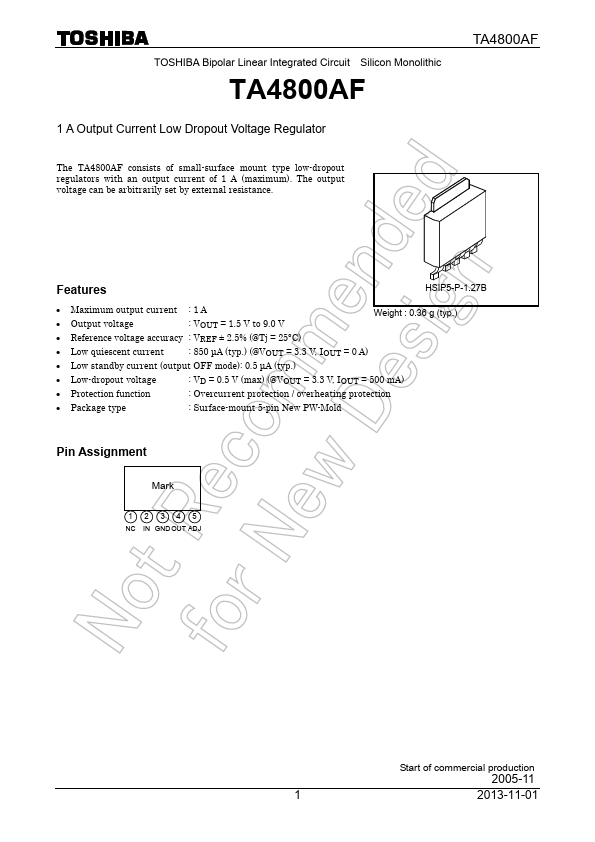
The TA4800AF consists of small-surface mount type low-dropout regulators with an output current of 1 A (maximum). The output voltage can be arbitrarily set by external resistance.
Features
HSIP5-P-1.27B
- Maximum output current : 1 A
- Output voltage
: VOUT = 1.5 V to 9.0 V
Weight : 0.36 g (typ.)
- Reference voltage accuracy : VREF ± 2.5% (@Tj = 25°C)
- Low quiescent current
: 850 μA (typ.) (@VOUT = 3.3 V, IOUT = 0 A)
- Low standby current (output OFF mode): 0.5 μA (typ.)
- Low-dropout voltage
: VD = 0.5 V (max) (@VOUT = 3.3 V, IOUT = 500 m A)
- Protection function
: Overcurrent protection / overheating protection
- Package type
: Surface-mount 5-pin New PW-Mold
Pin Assignment
Mark
12345 NC IN GND OUT ADJ
Start of mercial production
2005-11
2013-11-01
Marking
Part No. (or abbreviation code) Lot No. Note 1
Note 1: A line under a Lot No. identifies the indication of product Labels. Not underlined: [[Pb]]/INCLUDES > MCV Underlined: [[G]]/Ro HS PATIBLE or [[G]]/Ro HS [[Pb]]
Please contact your TOSHIBA sales representative for details as to environmental matters such as the Ro HS patibility of Product. The Ro HS is the Directive 2011/65/EU of the European Parliament and of the Council of 8 June 2011 on the restriction of the use of certain hazardous substances in electrical and electronic equipment.
The product(s) in this document (“Product”) contain functions intended to protect the Product from temporary small overloads such as minor short-term overcurrent or overheating. The protective functions do not necessarily protect Product under all circumstances. When incorporating Product into your system, please design the system (1) to avoid such overloads upon the Product, and (2) to shut down or otherwise relieve the Product of such overload conditions immediately upon occurrence. For...