TA8050P
TA8050P is 1.5A MOTOR DRIVER manufactured by Toshiba.
FEATURES l Bidirectional DC motor driver l Current capacity
: 1.5A l Four modes
: Forward, Reverse, Stop, and Brake
Weight: 1.9 g (typ.) l Remended operating supply voltage range: VCC = 6V to 16V l Protective functions : Thermal Shutdown, Short Circuit Protection, and Overvoltage Shutdown l Built-in diode for counteracting counter electromotive force l Plastic HSIP-7 pin
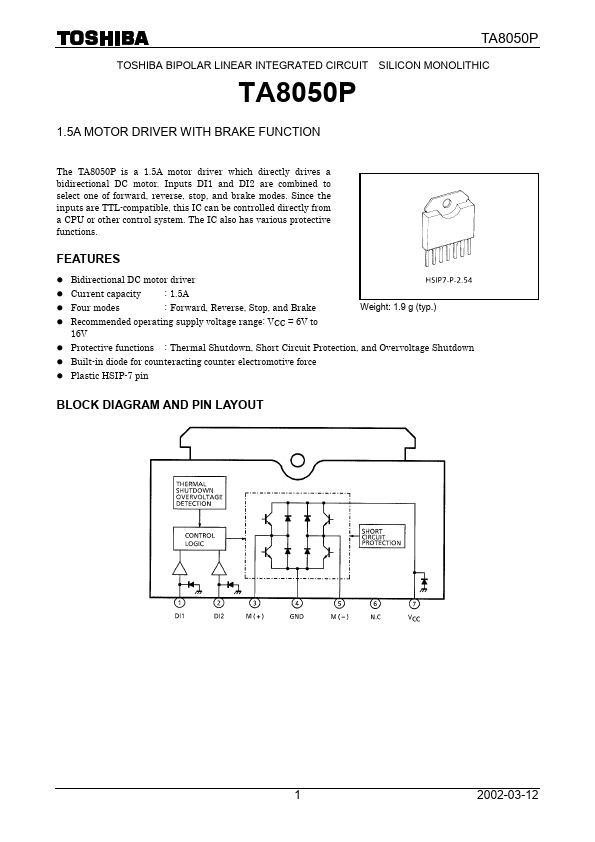
BLOCK DIAGRAM AND PIN LAYOUT
1 2002-03-12
PIN DESCRIPTION
PIN No. 1 2 3 4 5 6 7
SYMBOL DI1 DI2 M (+) GND M (- ) NC VCC
DESCRIPTION
Output status control pin. Connects to a PNP-type voltage parator.
Connects to the DC motor. Both the sink and the source have a current capacity of 1.5A. Diodes for absorbing counter electromotive force are contained on the VCC and GND sides.
Grounded
Connects to the DC motor together with pin 3 and has the same function as pin 3. This pin is controlled by the inputs from pins 1 and 2.
Not connected. (Electrically, this pin is pletely open.)
Power supply pin. This pin has a function to turn off the output when the applied voltage exceeds 27.5V, thus protecting the IC and the load.
TRUTH TABLE
Input DI1 H
DI2 H H L L
M (+) L
Output
M (- ) L
OFF (high impedance)
(Note) (Note)
Note: Brake mode es into effect when both M (+) and M (- ) go low ; Stop mode es into effect when both M (+) and M (- ) turn OFF.
DESCRIPTION
OF MULTI-PROTECTIVE OPERATION
The TA8050P has functions for protection from overvoltage (VSD), overcurent (ISD), and overheat (TSD). These functions protect the IC (and the motor load in some cases) from deterioration or destruction due to power-related overstress. The three functions work independently. Each function is explained below.
2 2002-03-12
1. Overvoltage protection (VSD)
- Basic operation When the voltage supplied to the VCC pin is up to the VSD detection voltage, the output is controlled by the input signals. However, when the VCC voltage exceeds the detection voltage, the output enters...