

Datasheet4U Logo Datasheet4U.com

TSOP1138KA1 - Photo Modules for PCM Remote Control Systems

Download the TSOP1138KA1 datasheet PDF. This datasheet also covers the TSO variant, as both devices belong to the same photo modules for pcm remote control systems family and are provided as variant models within a single manufacturer datasheet.

Description

The TSOP11..KA1

series are miniaturized receivers for infrared remote control systems.

PIN diode and preamplifier are assembled on lead frame, the epoxy package is designed as IR filter.

The demodulated output signal can directly be decoded by a microprocessor.

Features

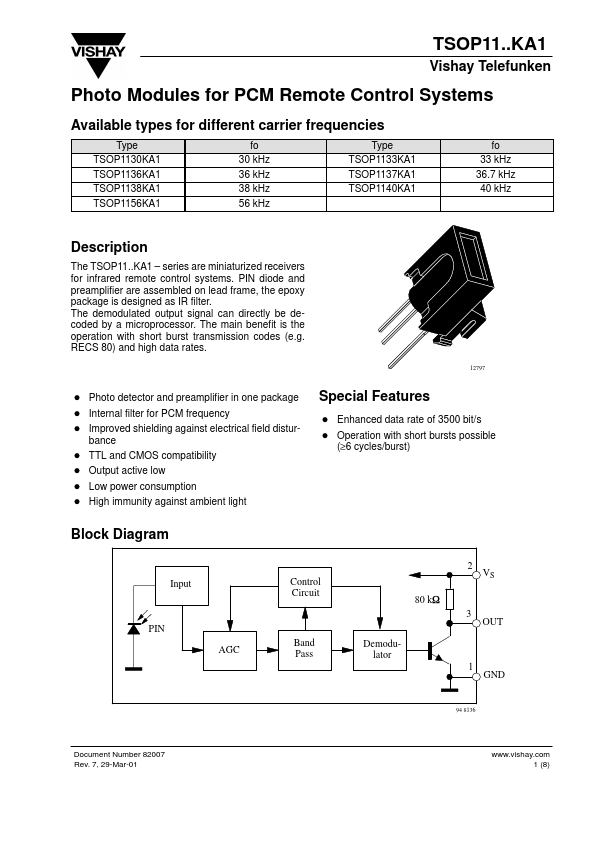
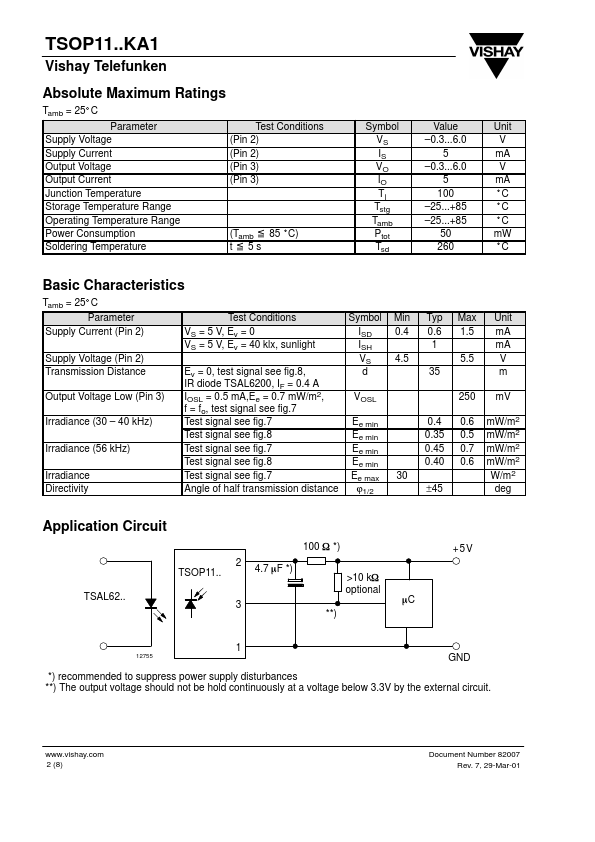
  • D Enhanced data rate of 3500 bit/s D Operation with short bursts possible (≥6 cycles/burst) D D D D TTL and CMOS compatibility Output active low Low power consumption High immunity against ambient light Block Diagram 2 Input Control Circuit 80 kW 3 PIN AGC Band Pass Demodulator 1 GND OUT VS 94 8136 Document Number 82007 Rev. 7, 29-Mar-01 www. vishay. com 1 (8) TSOP11.. KA1 Vishay Telefunken Absolute Maximum Ratings Tamb = 25_C Parameter Supply Voltage Supply Current Output Voltage Output Cur.

📥 Download Datasheet

Note: The manufacturer provides a single datasheet file (TSO-P1240K.pdf) that lists specifications for multiple related part numbers.

Datasheet Details

Part number TSOP1138KA1
Manufacturer Vishay
File Size Direct Link
Description Photo Modules for PCM Remote Control Systems
Datasheet download datasheet TSOP1138KA1 Datasheet

Full PDF Text Transcription

Click to expand full text
TSOP11..KA1 Vishay Telefunken Photo Modules for PCM Remote Control Systems Available types for different carrier frequencies Type TSOP1130KA1 TSOP1136KA1 TSOP1138KA1 TSOP1156KA1 fo 30 kHz 36 kHz 38 kHz 56 kHz Type TSOP1133KA1 TSOP1137KA1 TSOP1140KA1 fo 33 kHz 36.7 kHz 40 kHz Description The TSOP11..KA1 – series are miniaturized receivers for infrared remote control systems. PIN diode and preamplifier are assembled on lead frame, the epoxy package is designed as IR filter. The demodulated output signal can directly be decoded by a microprocessor. The main benefit is the operation with short burst transmission codes (e.g. RECS 80) and high data rates.
Published: |