

Datasheet4U Logo Datasheet4U.com

WM8144-10 - Integrated 10-bit Data Acquisition system for Imaging Applications

Download the WM8144-10 datasheet PDF. This datasheet also covers the WM8144 variant, as both devices belong to the same integrated 10-bit data acquisition system for imaging applications family and are provided as variant models within a single manufacturer datasheet.

Key Features

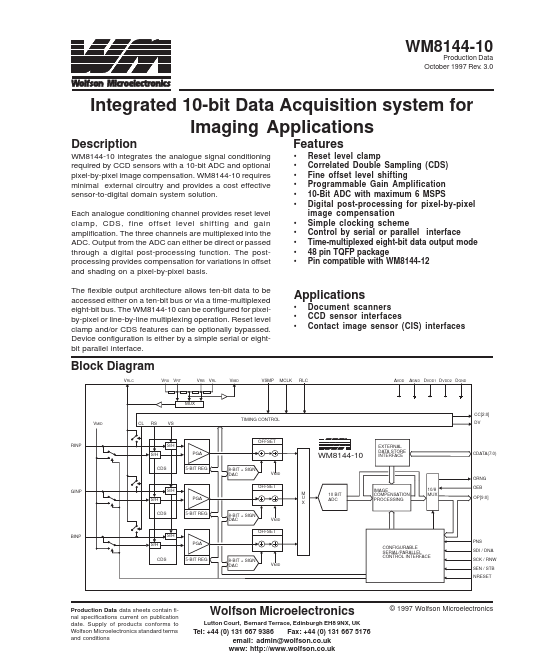
  • WM8144-10 integrates the analogue signal conditioning required by CCD sensors with a 10-bit ADC and optional pixel-by-pixel image compensation. WM8144-10 requires minimal external circuitry and provides a cost effective sensor-to-digital domain system solution. Each analogue conditioning channel provides reset level clamp, CDS, fine offset level shifting and gain amplification. The three channels are multiplexed into the ADC. Output from the ADC can either be direct or passed through a digital.

📥 Download Datasheet

Note: The manufacturer provides a single datasheet file (WM8144_WolfsonMicroelectronicsplc.pdf) that lists specifications for multiple related part numbers.

Datasheet Details

Part number WM8144-10
Manufacturer Wolfson Microelectronics plc
File Size 395.82 KB
Description Integrated 10-bit Data Acquisition system for Imaging Applications
Datasheet download datasheet WM8144-10 Datasheet

Full PDF Text Transcription (Reference)

The following content is an automatically extracted verbatim text from the original manufacturer datasheet and is provided for reference purposes only.

View original datasheet text
WM8144-10 Production Data October 1997 Rev. 3.0 Integrated 10-bit Data Acquisition system for Imaging Applications Description Features WM8144-10 integrates the analogue signal conditioning required by CCD sensors with a 10-bit ADC and optional pixel-by-pixel image compensation. WM8144-10 requires minimal external circuitry and provides a cost effective sensor-to-digital domain system solution. Each analogue conditioning channel provides reset level clamp, CDS, fine offset level shifting and gain amplification. The three channels are multiplexed into the ADC. Output from the ADC can either be direct or passed through a digital post-processing function. The postprocessing provides compensation for variations in offset and shading on a pixel-by-pixel basis.