XE1203
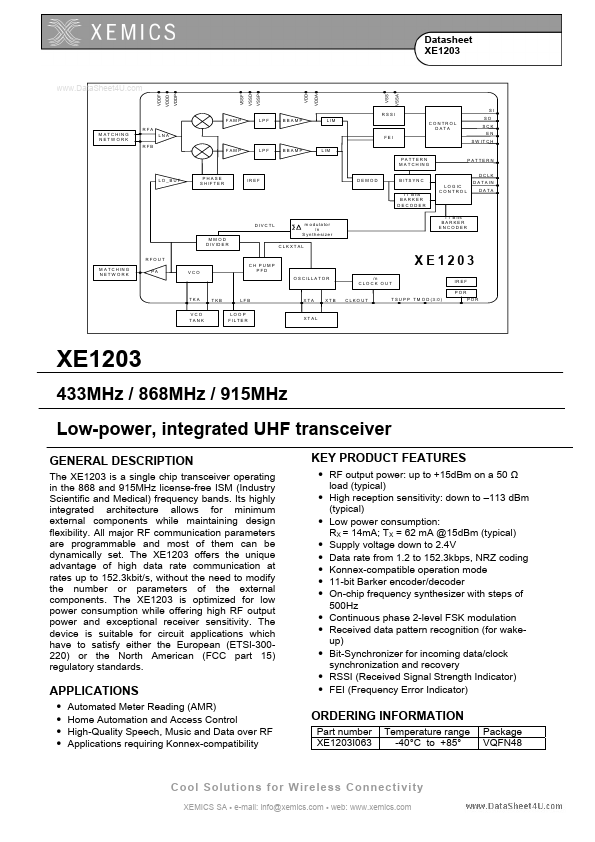
XE1203 is integrated UHF transceiver manufactured by Xemics.
DESCRIPTION
The XE1203 is a single chip transceiver operating in the 868 and 915MHz license-free ISM (Industry Scientific and Medical) frequency bands. Its highly integrated architecture allows for minimum external ponents while maintaining design flexibility. All major RF munication parameters are programmable and most of them can be dynamically set. The XE1203 offers the unique advantage of high data rate munication at rates up to 152.3kbit/s, without the need to modify the number or parameters of the external ponents. The XE1203 is optimized for low power consumption while offering high RF output power and exceptional receiver sensitivity. The device is suitable for circuit applications which have to satisfy either the European (ETSI-300220) or the North American (FCC part 15) regulatory standards.
KEY PRODUCT FEATURES
- RF output power: up to +15d Bm on a 50 Ω load (typical)
- High reception sensitivity: down to
- 113 d Bm (typical)
- Low power consumption: RX = 14m A; TX = 62 m A @15d Bm (typical)
- Supply voltage down to 2.4V
- Data rate from 1.2 to 152.3kbps, NRZ coding
- Konnex-patible operation mode
- 11-bit Barker encoder/decoder
- On-chip frequency synthesizer with steps of 500Hz
- Continuous phase 2-level FSK modulation
- Received data pattern recognition (for wakeup)
- Bit-Synchronizer for ining data/clock synchronization and recovery
- RSSI (Received Signal Strength Indicator)
- FEI (Frequency Error Indicator)
APPLICATIONS
- -
- - Automated Meter Reading (AMR) Home Automation and Access Control High-Quality Speech, Music and Data over RF Applications requiring Konnex-patibility
ORDERING INFORMATION
Part number XE1203I063 Temperature range -40°C to +85° Package VQFN48
Cool Solutions for Wireless Connectivity
XEMICS SA
- e-mail: info@xemics.
- web: .xemics.
Data Sheet XE1203
..
Table of Contents
1 2 3 3.1 3.2 3.2.1 3.2.2
Functional Block Diagram...