AMC22C12-Q1
AMC22C12-Q1 is Basic Isolated Window Comparator manufactured by Texas Instruments.
Features
- AEC-Q100 qualified for automotive applications:
- Temperature grade 1:
- 40°C to +125°C, TA
- Wide high-side supply range: 3 V to 25 V
- Low-side supply range: 2.7 V to 5.5 V
- Adjustable threshold:
- Window-parator mode: ±20 m V to ±300 m V
- Positive-parator mode: 600 m V to 2.7 V
- Reference for threshold adjustment: 100 μA, ±1%
- Trip threshold error: ±1% (max) at 250 m V
- Open-drain output with optional latch mode
- Propagation delay: 280 ns (typ)
- High CMTI: 55 V/ns (min)
- Safety-related certifications:
- 4250-VPK basic isolation per DIN EN IEC 60747-17 (VDE 0884-17)
- 3000-VRMS isolation for 1 minute per UL1577
2 Applications
- Overcurrent or overvoltage detection in:
- HEV/EV charging piles
- HEV/EV onboard chargers (OBC)
- HEV/EV DC/DC converters
- HEV/EV traction inverters
3 Description
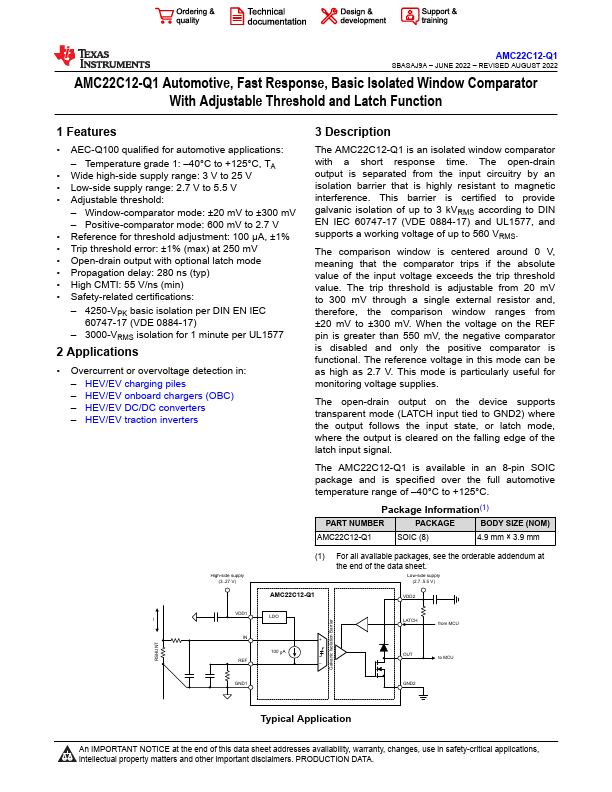
The AMC22C12-Q1 is an isolated window parator with a short response time. The open-drain output is separated from the input circuitry by an isolation barrier that is highly resistant to magnetic interference. This barrier is certified to provide galvanic isolation of up to 3 k VRMS according to DIN EN IEC 60747-17 (VDE 0884-17) and UL1577, and supports a working voltage of up to 560 VRMS.
The parison window is centered around 0 V, meaning that the parator trips if the absolute value of the input voltage exceeds the trip threshold value. The trip threshold is adjustable from 20 m V to 300 m V through a single external resistor and, therefore, the parison window ranges from ±20 m V to ±300 m V. When the voltage on the REF pin is greater than 550 m V, the negative parator is disabled and only the positive parator is functional. The reference voltage in this mode can be as high as 2.7 V. This mode is particularly useful for monitoring voltage supplies.
The open-drain output on the device supports transparent mode (LATCH input tied to GND2) where the output follows the input state, or latch mode, where the output is cleared on the falling edge of the latch input...