DS90LV049
DS90LV049 is 3V LVDS Dual Line Driver manufactured by Texas Instruments.
FEATURES
- 2 Up to 400 Mbps Switching Rates
- Flow-Through Pinout Simplifies PCB Layout
- 50 ps Typical Driver Channel-to-Channel Skew
- 50 ps Typical Receiver Channel-to-Channel
Skew
- 3.3 V Single Power Supply Design
- TRI-STATE Output Control
- Internal Fail-Safe Biasing of Receiver Inputs
- Low Power Dissipation (70 m W at 3.3 V Static)
- High Impedance on LVDS Outputs on Power
Down
- Conforms to TIA/EIA-644-A LVDS Standard
- Industrial Operating Temperature Range
(- 40°C to +85°C)
- Available in Low Profile 16 Pin TSSOP
Package
DESCRIPTION
The DS90LV049 is a dual CMOS flow-through differential line driver-receiver pair designed for applications requiring ultra low power dissipation, exceptional noise immunity, and high data throughput. The device is designed to support data rates in excess of 400 Mbps utilizing Low Voltage Differential Signaling (LVDS) technology.
The DS90LV049 drivers accept LVTTL/LVCMOS signals and translate them to LVDS signals. On the other hand, the receivers accept LVDS signals and translate them to 3 V CMOS signals. The LVDS input buffers have internal failsafe biasing that places the outputs to a known H (high) state for floating receiver inputs. In addition, the DS90LV049 supports a TRISTATE function for a low idle power state when the device is not in use.
The EN and EN inputs are ANDed together and control the TRI-STATE outputs. The enables are mon to all four gates.
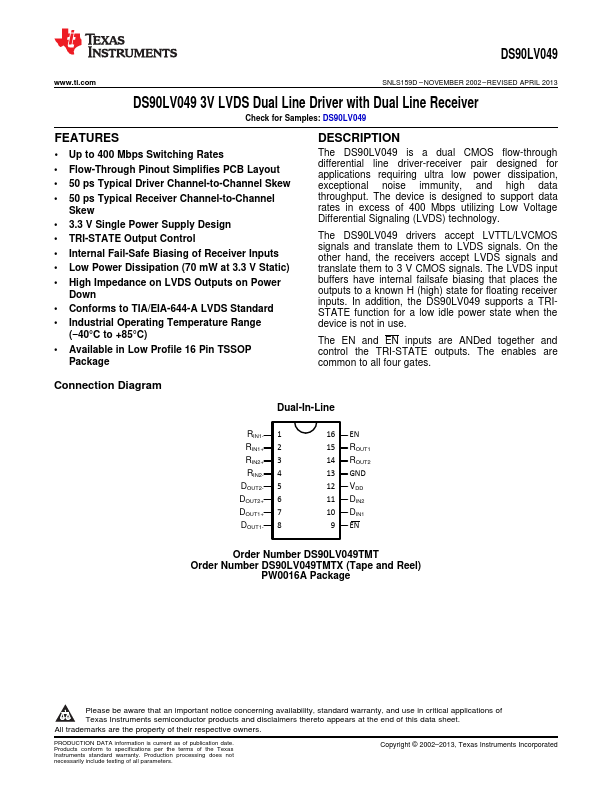
Connection Diagram
Dual-In-Line
RIN1- 1 RIN1+ 2 RIN2+ 3 RIN2- 4 DOUT2- 5 DOUT2+ 6 DOUT1+ 7 DOUT1- 8
16 EN
15 ROUT1 14 ROUT2 13 GND
12 VDD 11 DIN2 10 DIN1
9 EN
Order Number DS90LV049TMT Order Number DS90LV049TMTX (Tape and Reel)
PW0016A Package
Please be aware that an important notice concerning availability, standard warranty, and use in critical applications of Texas Instruments semiconductor products and disclaimers thereto appears at the end of this data sheet. All trademarks are the property of their respective owners.
PRODUCTION DATA information is...