• Part: LMR23615
  • Description: 1.5-A Synchronous Step-Down Converter
  • Manufacturer: Texas Instruments
  • Size: 3.01 MB
Download LMR23615 Datasheet PDF
Texas Instruments
LMR23615
LMR23615 is 1.5-A Synchronous Step-Down Converter manufactured by Texas Instruments.
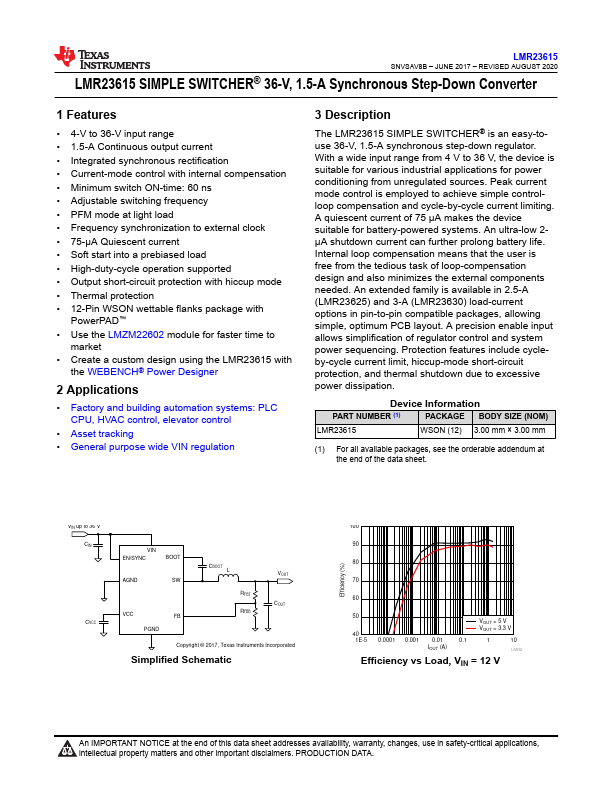
Features - 4-V to 36-V input range - 1.5-A Continuous output current - Integrated synchronous rectification - Current-mode control with internal pensation - Minimum switch ON-time: 60 ns - Adjustable switching frequency - PFM mode at light load - Frequency synchronization to external clock - 75-µA Quiescent current - Soft start into a prebiased load - High-duty-cycle operation supported - Output short-circuit protection with hiccup mode - Thermal protection - 12-Pin WSON wettable flanks package with Power PAD™ - Use the LMZM22602 module for faster time to market - Create a custom design using the LMR23615 with the WEBENCH® Power Designer 2 Applications - Factory and building automation systems: PLC CPU, HVAC control, elevator control - Asset tracking - General purpose wide VIN regulation VIN up to 36 V CIN CVCC VIN EN/SYNC BOOT AGND PGND CBOOT L RFBT RFBB VOUT COUT Copyright © 2017, Texas Instruments Incorporated Simplified Schematic 3 Description The LMR23615 SIMPLE SWITCHER® is an easy-touse 36-V, 1.5-A synchronous step-down regulator. With a wide input range from 4 V to 36 V, the device is suitable for various industrial applications for power conditioning from unregulated sources. Peak current mode control is employed to achieve simple controlloop pensation and cycle-by-cycle current limiting. A quiescent current of 75 µA makes the device suitable for battery-powered systems. An ultra-low 2µA shutdown current can further prolong battery life. Internal loop pensation means that the user is free from the tedious task of loop-pensation design and also minimizes the external ponents needed. An extended family is available in 2.5-A (LMR23625) and 3-A (LMR23630) load-current options in pin-to-pin patible packages, allowing simple, optimum PCB layout. A precision enable input allows simplification of regulator control and system power sequencing. Protection features include cycleby-cycle current limit, hiccup-mode short-circuit protection, and...