LMR23630
LMR23630 is 3-A Synchronous Step-Down Converter manufactured by Texas Instruments.
Features
- 4-V to 36-V Input range
- 3-A Continuous output current
- Integrated synchronous rectification
- Current-mode control
- Minimum switch on-time: 60 ns
- Internal pensation for ease of use
- 400-k Hz Switching frequency and adjustable frequency options
- PFM and forced PWM mode options
- Frequency synchronization to external clock
- 75-µA Quiescent current at no load for PFM option
- Soft start into a prebiased load
- High duty-cycle operation supported
- Precision enable input
- Output short-circuit protection with hiccup mode
- Thermal protection
- 8-Pin HSOIC with Power PAD™ package
- 12-Pin WSON wettable flanks package with
Power PAD™
- Use the LMZM33603 module for faster time to market
- Create a custom design using the LMR23625 with the WEBENCH® Power Designer
2 Applications
- Factory and building automation systems: PLC CPU, HVAC control, elevator control
- Assest tracking
- General purpose wide VIN regulation
VIN up to 36 V
CIN VIN
EN/SYNC
BOOT
AGND
CVCC
PGND
CBOOT L RFBT RFBB
VOUT COUT
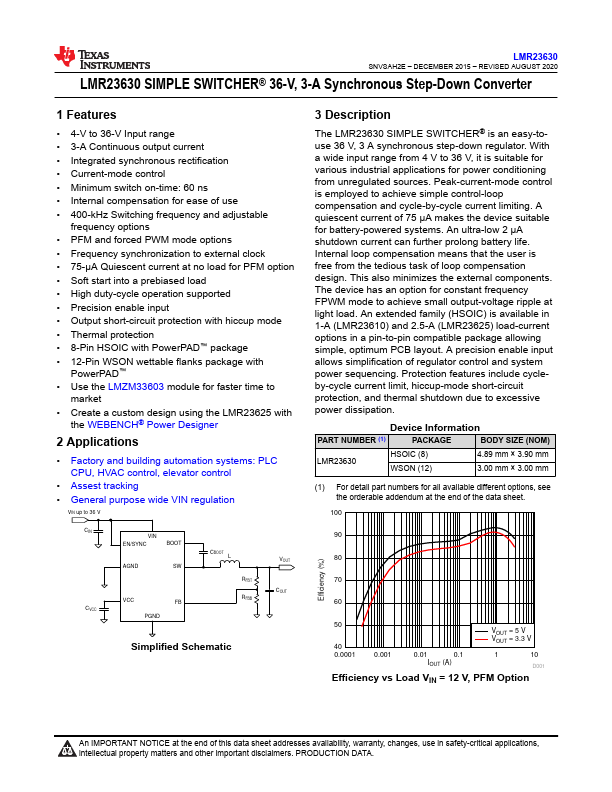
Simplified Schematic
3 Description
The LMR23630 SIMPLE SWITCHER® is an easy-touse 36 V, 3 A synchronous step-down regulator. With a wide input range from 4 V to 36 V, it is suitable for various industrial applications for power conditioning from unregulated sources. Peak-current-mode control is employed to achieve simple control-loop pensation and cycle-by-cycle current limiting. A quiescent current of 75 μA makes the device suitable for battery-powered systems. An ultra-low 2 μA shutdown current can further prolong battery life. Internal loop pensation means that the user is free from the tedious task of loop pensation design. This also minimizes the external ponents. The device has an option for constant frequency FPWM mode to achieve small output-voltage ripple at light load. An extended family (HSOIC) is available in 1-A (LMR23610) and 2.5-A (LMR23625) load-current options in a pin-to-pin patible package allowing simple, optimum PCB layout....