SN54LVC646A-SP
SN54LVC646A-SP is OCTAL BUS TRANSCEIVERS.REGISTERS manufactured by Texas Instruments.
FEATURES
- Operates From 1.65 V to 3.6 V
- Inputs Accept Voltages to 5.5 V
- Max tpd of 7.4 ns at 3.3 V
- Typical VOLP (Output Ground Bounce)
<0.8 at VCC = 3.3 V, TA = 25°C
- Typical VOHV (Output VOH Undershoot)
>2 V at VCC = 3.3 V, TA = 25°C
- Supports Mixed-Mode Signal Operation on All
Ports (5-V Input/Output Voltage With 3.3-V VCC)
- Ioff Supports Partial Power-Down-Mode Operation
- Latch-Up Performance Exceeds 250 m A Per JESD 17
- ESD Protection Exceeds JESD 22
- 2000-V Human-Body Model (A114-A)
- 200-V Machine Model (A115-A)
- 1000-V Charged-Device Model (C101)
- Rad Tolerant: 50k Rad (Si) TID (1)
- TID Dose Rate 0.10 rad/s
- QML-V Qualified, SMD 5962-97626
(1) Radiation tolerance is a typical value based upon initial device qualification. Radiation Lot Acceptance Testing is available
- contact factory for details.
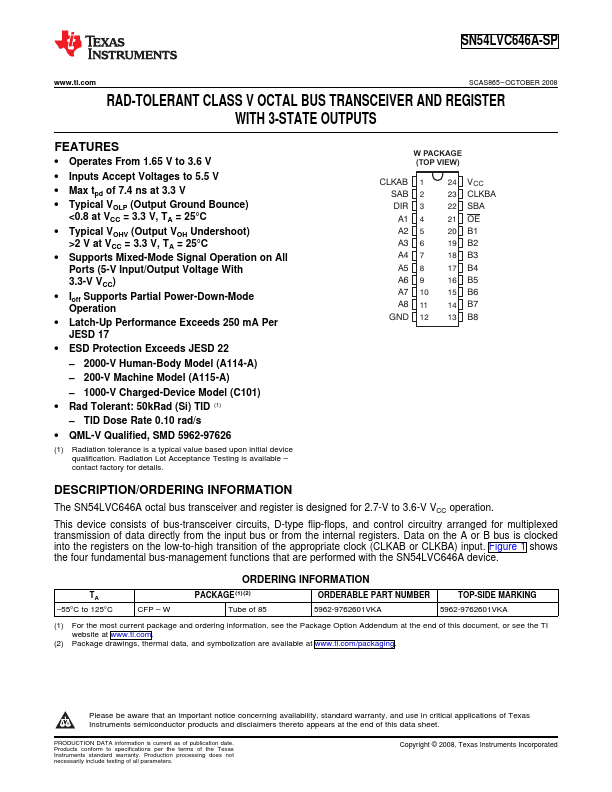
W PACKAGE (TOP VIEW)
CLKAB 1 SAB 2 DIR 3 A1 4 A2 5 A3 6 A4 7 A5 8 A6 9 A7 10 A8 11 GND 12
24 VCC 23 CLKBA 22 SBA 21 OE 20 B1 19 B2 18 B3 17 B4 16 B5 15 B6 14 B7 13 B8
DESCRIPTION
/ORDERING INFORMATION
The SN54LVC646A octal bus transceiver and register is designed for 2.7-V to 3.6-V VCC operation.
This device consists of bus-transceiver circuits, D-type flip-flops, and control circuitry arranged for multiplexed transmission of data directly from the input bus or from the internal registers. Data on the A or B bus is clocked into the registers on the low-to-high transition of the appropriate clock (CLKAB or CLKBA) input. Figure 1 shows the four fundamental bus-management functions that are performed with the SN54LVC646A device.
- 55°C to 125°C
- W
ORDERING INFORMATION
PACKAGE (1) (2)
ORDERABLE PART NUMBER
Tube of 85
5962-9762601VKA
TOP-SIDE MARKING 5962-9762601VKA
(1) For the most current package and ordering information, see the Package Option Addendum at the end of this document, or see the TI website at...