• Part: SN65MLVD203
  • Description: MULTIPOINT-LVDS LINE DRIVER AND RECEIVER
  • Manufacturer: Texas Instruments
  • Size: 888.11 KB
Download SN65MLVD203 Datasheet PDF
Texas Instruments
SN65MLVD203
SN65MLVD203 is MULTIPOINT-LVDS LINE DRIVER AND RECEIVER manufactured by Texas Instruments.
- Part of the SN65MLVD201 comparator family.
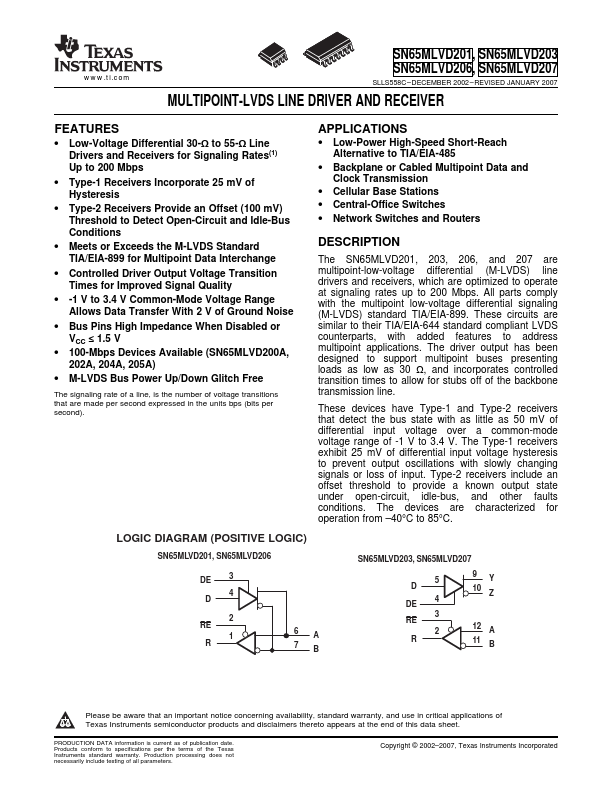
FEATURES - Low-Voltage Differential 30-Ω to 55-Ω Line Drivers and Receivers for Signaling Rates(1) Up to 200 Mbps - Type-1 Receivers Incorporate 25 m V of Hysteresis - Type-2 Receivers Provide an Offset (100 m V) Threshold to Detect Open-Circuit and Idle-Bus Conditions - Meets or Exceeds the M-LVDS Standard TIA/EIA-899 for Multipoint Data Interchange - Controlled Driver Output Voltage Transition Times for Improved Signal Quality - -1 V to 3.4 V mon-Mode Voltage Range Allows Data Transfer With 2 V of Ground Noise - Bus Pins High Impedance When Disabled or VCC ≤ 1.5 V - 100-Mbps Devices Available (SN65MLVD200A, 202A, 204A, 205A) - M-LVDS Bus Power Up/Down Glitch Free The signaling rate of a line, is the number of voltage transitions that are made per second expressed in the units bps (bits per second). APPLICATIONS - Low-Power High-Speed Short-Reach Alternative to TIA/EIA-485 - Backplane or Cabled Multipoint Data and Clock Transmission - Cellular Base Stations - Central-Office Switches - Network Switches and Routers DESCRIPTION The SN65MLVD201, 203, 206, and 207 are multipoint-low-voltage differential (M-LVDS) line drivers and receivers, which are optimized to operate at signaling rates up to 200 Mbps. All parts ply with the multipoint low-voltage differential signaling (M-LVDS) standard TIA/EIA-899. These circuits are similar to their TIA/EIA-644 standard pliant LVDS counterparts, with added features to address multipoint applications. The driver output has been designed to support multipoint buses presenting loads as low as 30 Ω, and incorporates controlled transition times to allow for stubs off of the backbone transmission line. These devices have Type-1 and Type-2 receivers that detect the bus state with as little as 50 m V of differential input voltage over a mon-mode voltage range of -1 V to 3.4 V. The Type-1 receivers exhibit 25 m V of differential input voltage hysteresis to prevent output oscillations with slowly changing signals or loss of input. Type-2...