SN74AHC74
SN74AHC74 is Dual Positive-Edge-Triggered D-Type Flip-Flop manufactured by Texas Instruments.
SN54AHC74, SN74AHC74
.ti.
SCLS255K
- DECEMBER 1995
- REVISED DECEMBER 2013
Dual Positive-Edge-Triggered D-Type Flip-Flops With Clear and Preset
Check for Samples: SN54AHC74, SN74AHC74
Features
- Operating Range 2-V to 5.5-V VCC
- Latch-Up Performance Exceeds 250 m A Per
JESD 17
- ESD Protection Exceeds JESD 22
- 2000-V Human-Body Model (A114-A)
- 200-V Machine Model (A115-A)
- 1000-V Charged-Device Model (C101)
DESCRIPTION
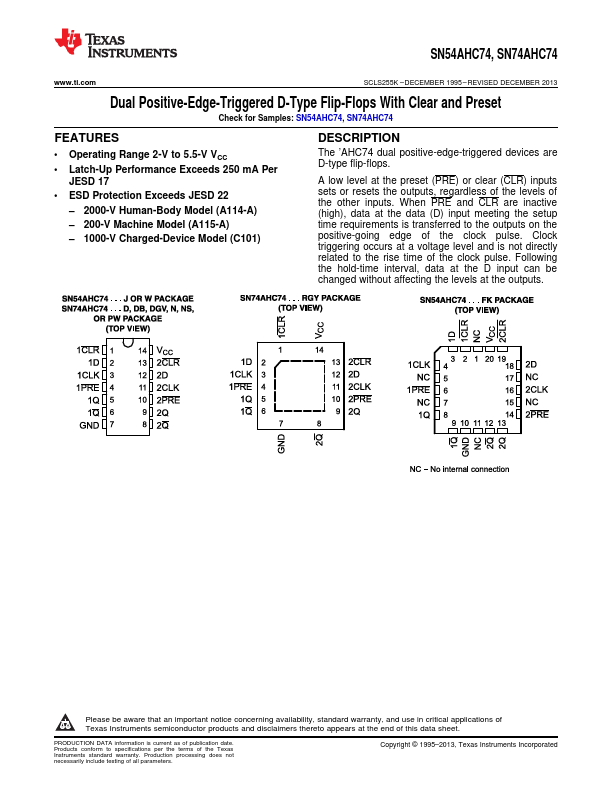
The ’AHC74 dual positive-edge-triggered devices are D-type flip-flops.
A low level at the preset (PRE) or clear (CLR) inputs sets or resets the outputs, regardless of the levels of the other inputs. When PRE and CLR are inactive (high), data at the data (D) input meeting the setup time requirements is transferred to the outputs on the positive-going edge of the clock pulse. Clock triggering occurs at a voltage level and is not directly related to the rise time of the clock pulse. Following the hold-time interval, data at the D input can be changed without affecting the levels at the outputs.
Please be aware that an important notice concerning availability, standard warranty, and use in critical applications of Texas Instruments semiconductor products and disclaimers thereto appears at the end of this data sheet.
PRODUCTION DATA information is current as of publication date. Products conform to specifications per the terms of the Texas Instruments standard warranty. Production processing does not necessarily include testing of all parameters.
Copyright © 1995- 2013, Texas Instruments Incorporated
SN54AHC74, SN74AHC74
SCLS255K
- DECEMBER 1995
- REVISED DECEMBER 2013
.ti.
These devices have limited built-in ESD protection. The leads should be shorted together or the device placed in conductive foam during storage or handling to prevent electrostatic damage to the MOS gates.
Table 1. Function Table (Each Flip-Flop)
INPUTS
OUTPUTS...