• Part: SN74ALVCH32973
  • Description: 16-BIT BUS TRANSCEIVER AND TRANSPARENT D-TYPE LATCH
  • Manufacturer: Texas Instruments
  • Size: 801.56 KB
Download SN74ALVCH32973 Datasheet PDF
Texas Instruments
SN74ALVCH32973
SN74ALVCH32973 is 16-BIT BUS TRANSCEIVER AND TRANSPARENT D-TYPE LATCH manufactured by Texas Instruments.
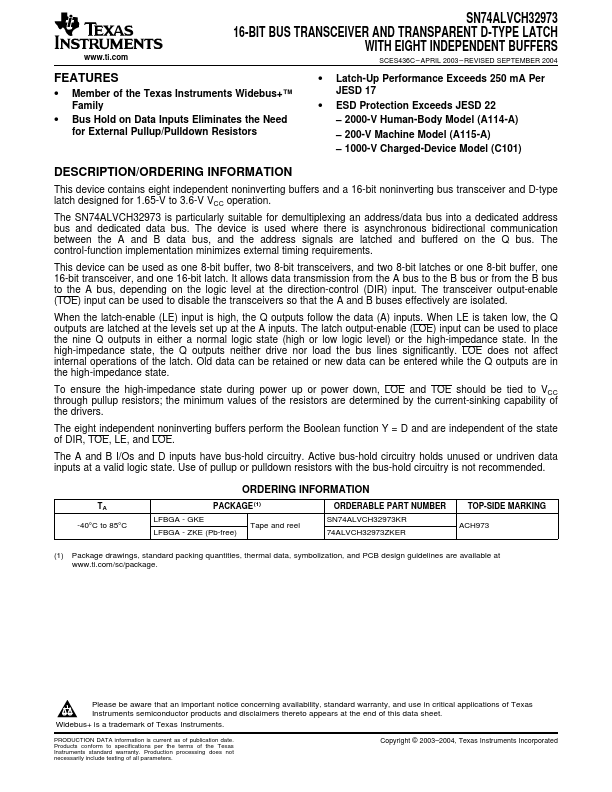
FEATURES - Member of the Texas Instruments Widebus+™ Family - Bus Hold on Data Inputs Eliminates the Need for External Pullup/Pulldown Resistors - Latch-Up Performance Exceeds 250 m A Per JESD 17 - ESD Protection Exceeds JESD 22 - 2000-V Human-Body Model (A114-A) - 200-V Machine Model (A115-A) - 1000-V Charged-Device Model (C101) DESCRIPTION /ORDERING INFORMATION This device contains eight independent noninverting buffers and a 16-bit noninverting bus transceiver and D-type latch designed for 1.65-V to 3.6-V VCC operation. The SN74ALVCH32973 is particularly suitable for demultiplexing an address/data bus into a dedicated address bus and dedicated data bus. The device is used where there is asynchronous bidirectional munication between the A and B data bus, and the address signals are latched and buffered on the Q bus. The control-function implementation minimizes external timing requirements. This device can be used as one 8-bit buffer, two 8-bit transceivers, and two 8-bit latches or one 8-bit buffer, one 16-bit transceiver, and one 16-bit latch. It allows data transmission from the A bus to the B bus or from the B bus to the A bus, depending on the logic level at the direction-control (DIR) input. The transceiver output-enable (TOE) input can be used to disable the transceivers so that the A and B buses effectively are isolated. When the latch-enable (LE) input is high, the Q outputs follow the data (A) inputs. When LE is taken low, the Q outputs are latched at the levels set up at the A inputs. The latch output-enable (LOE) input can be used to place the nine Q outputs in either a normal logic state (high or low logic level) or the high-impedance state. In the high-impedance state, the Q outputs neither drive nor load the bus lines significantly. LOE does not affect internal operations of the latch. Old data can be retained or new data can be entered while the Q outputs are in the high-impedance state. To ensure the high-impedance state during power up or power...