

Datasheet4U Logo Datasheet4U.com

SN74HCT138N - 3-Line to 8-Line Decoders/Demultiplexers

Download the SN74HCT138N datasheet PDF. This datasheet also covers the SN74HCT138 variant, as both devices belong to the same 3-line to 8-line decoders/demultiplexers family and are provided as variant models within a single manufacturer datasheet.

General Description

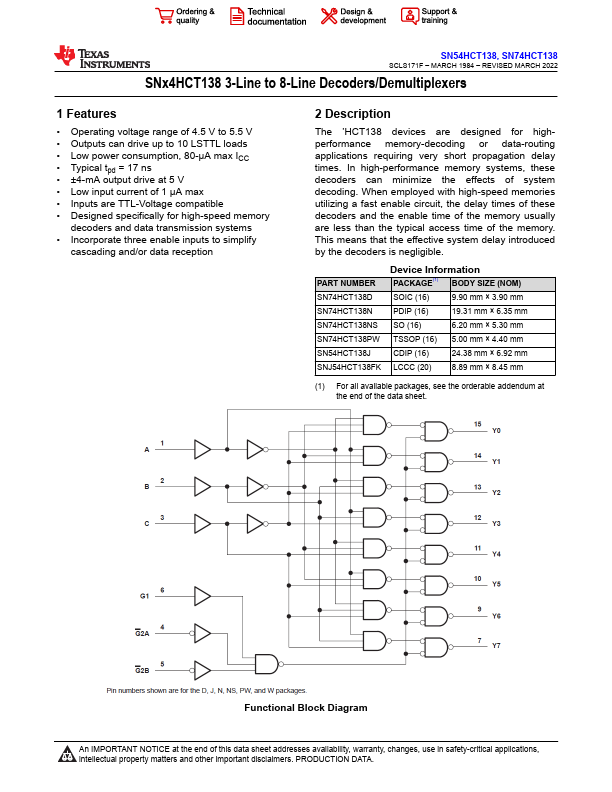
The ’HCT138 devices are designed for highperformance memory-decoding or data-routing applications requiring very short propagation delay times.

In high-performance memory systems, these decoders can minimize the effects of system decoding.

Key Features

  • Operating voltage range of 4.5 V to 5.5 V.
  • Outputs can drive up to 10 LSTTL loads.
  • Low power consumption, 80-µA max ICC.
  • Typical tpd = 17 ns.
  • ±4-mA output drive at 5 V.
  • Low input current of 1 µA max.
  • Inputs are TTL-Voltage compatible.
  • Designed specifically for high-speed memory decoders and data transmission systems.
  • Incorporate three enable inputs to simplify cascading and/or data reception 2.
📥 Download Datasheet

Note: The manufacturer provides a single datasheet file (SN74HCT138-etcTI.pdf) that lists specifications for multiple related part numbers.

Full PDF Text Transcription (Reference)

The following content is an automatically extracted verbatim text from the original manufacturer datasheet and is provided for reference purposes only.

View original datasheet text
SN54HCT138, SN74HCT138 SCLS171F – MARCH 1984 – REVISED MARCH 2022 SNx4HCT138 3-Line to 8-Line Decoders/Demultiplexers 1 Features • Operating voltage range of 4.5 V to 5.5 V • Outputs can drive up to 10 LSTTL loads • Low power consumption, 80-µA max ICC • Typical tpd = 17 ns • ±4-mA output drive at 5 V • Low input current of 1 µA max • Inputs are TTL-Voltage compatible • Designed specifically for high-speed memory decoders and data transmission systems • Incorporate three enable inputs to simplify cascading and/or data reception 2 Description The ’HCT138 devices are designed for highperformance memory-decoding or data-routing applications requiring very short propagation delay times. In high-performance memory systems, these decoders can minimize the effects of system decoding.