SN75971B
SN75971B is SCSI DIFFERENTIAL CONVERTER-DATA manufactured by Texas Instruments.
description
GND 14 GND 15
43 GND 42 GND
The SN75971B SCSI differential converter-data is a 9-channel RS-485 transceiver. When used in conjunction with its panion control transceiver, the SN75970B, the resulting chip set provides the superior electrical performance of differential SCSI from a single-ended SCSI bus or controller. A 16-bit Ultra-SCSI (or Fast-20) SCSI bus can be implemented
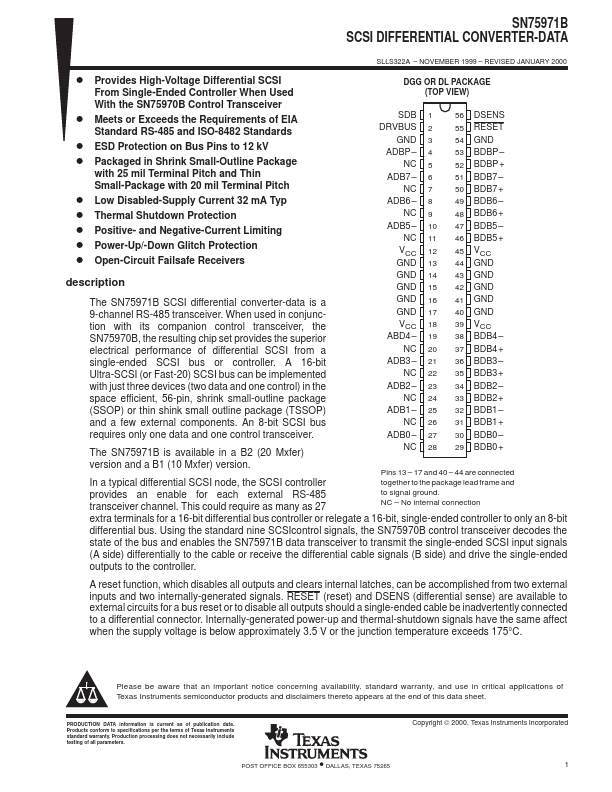
GND 16 GND 17 VCC 18 ABD4
- 19
NC 20 ADB3
- 21
NC 22
41 GND 40 GND 39 VCC 38 BDB4
- 37 BDB4 + 36 BDB3
- 35 BDB3 + with just three devices (two data and one control) in the
ADB2
- 23 34 BDB2
- space efficient, 56-pin, shrink small-outline package
NC 24 33 BDB2 +
(SSOP) or thin shink small outline package (TSSOP)
ADB1
- 25 32 BDB1
- and a few external ponents. An 8-bit SCSI bus
NC 26 31 BDB1 + requires only one data and one control transceiver.
ADB0
- 27 30 BDB0
- The SN75971B is available in a B2 (20 Mxfer)
NC 28 29 BDB0 + version and a B1 (10 Mxfer) version.
Pins 13
- 17 and 40
- 44 are connected
In a typical differential SCSI node, the SCSI controller provides an enable for each external RS-485 transceiver channel. This could require as many as 27 together to the package lead frame and to signal ground. NC
- No internal connection extra terminals for a 16-bit differential bus controller or relegate a 16-bit, single-ended controller to only an 8-bit differential bus. Using the standard nine SCSIcontrol signals, the SN75970B control transceiver decodes the state of the bus and enables the SN75971B data transceiver to transmit the single-ended SCSI input signals
(A side) differentially to the cable or receive the differential cable signals (B side) and drive the single-ended outputs to the controller.
A reset function, which disables all outputs and clears internal latches, can be acplished from two external inputs and two internally-generated signals. RESET (reset) and DSENS (differential sense) are available to external circuits for a bus reset or to...