TL1593C
TL1593C is 3-CHANNEL SAMPLE-AND-HOLD CIRCUIT manufactured by Texas Instruments.
TL1593C 3-CHANNEL SAMPLE-AND-HOLD CIRCUIT
- Designed for Use With TI Virtual-Phase
CCD Image Sensors
- Supports Both Color and Monochrome
Applications
- Contains Three Separate Sample-and-Hold
Circuits
- Differential Input With 11-d B Gain
- 5-MHz Sampling Rate on Each Channel
- Separate Analog and Digital Supplies for
Immunity to Switching Transients
SOCS027B
- APRIL 1987
- REVISED JULY 1991
NS PACKAGE (TOP VIEW)
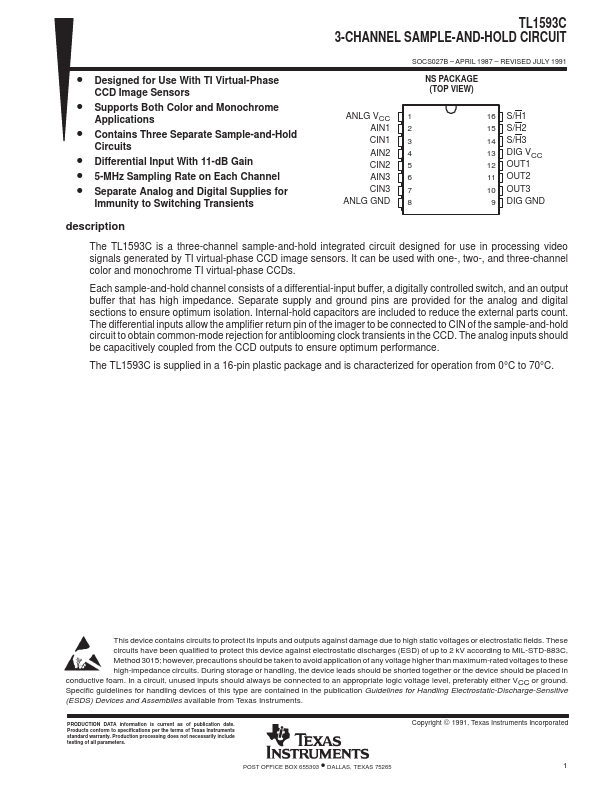
ANLG VCC 1 AIN1 2 CIN1 3 AIN2 4 CIN2 5 AIN3 6 CIN3 7
ANLG GND 8
16 S/H1 15 S/H2 14 S/H3 13 DIG VCC 12 OUT1 11 OUT2 10 OUT3 9 DIG GND description
The TL1593C is a three-channel sample-and-hold integrated circuit designed for use in processing video signals generated by TI virtual-phase CCD image sensors. It can be used with one-, two-, and three-channel color and monochrome TI virtual-phase CCDs.
Each sample-and-hold channel consists of a differential-input buffer, a digitally controlled switch, and an output buffer that has high impedance. Separate supply and ground pins are provided for the analog and digital sections to ensure optimum isolation. Internal-hold capacitors are included to reduce the external parts count. The differential inputs allow the amplifier return pin of the imager to be connected to CIN of the sample-and-hold circuit to obtain mon-mode rejection for antiblooming clock transients in the CCD. The analog inputs should be capacitively coupled from the CCD outputs to ensure optimum performance.
The TL1593C is supplied in a 16-pin plastic package and is characterized for operation from 0°C to 70°C.
This device contains circuits to protect its inputs and outputs against damage due to high static voltages or electrostatic fields. These circuits have been qualified to protect this device against electrostatic discharges (ESD) of up to 2 k V according to MIL-STD-883C, Method 3015; however, precautions should be taken to avoid application of any voltage higher than maximum-rated voltages to these high-impedance circuits. During...