Datasheet4U Logo Datasheet4U.com

TLC5927 - 16-Channel Constant-Current LED Sink Drivers

This page provides the datasheet information for the TLC5927, a member of the TLC5926 16-Channel Constant-Current LED Sink Drivers family.

Description

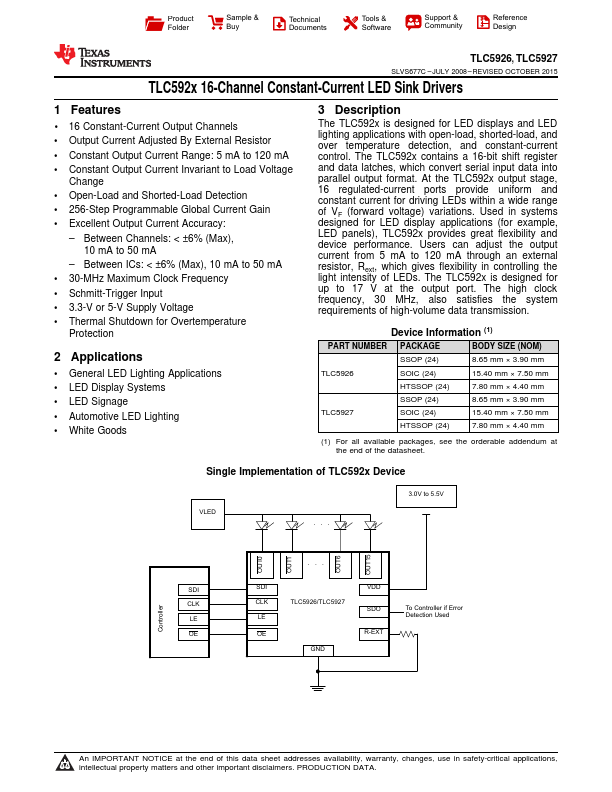
The TLC592x is designed for LED displays and LED lighting applications with open-load, shorted-load, and over temperature detection, and constant-current control.

The TLC592x contains a 16-bit shift register and data latches, which convert serial input data into parallel output format.

Features

  • 1 16 Constant-Current Output Channels.
  • Output Current Adjusted By External Resistor.
  • Constant Output Current Range: 5 mA to 120 mA.
  • Constant Output Current Invariant to Load Voltage Change.
  • Open-Load and Shorted-Load Detection.
  • 256-Step Programmable Global Current Gain.
  • Excellent Output Current Accuracy:.
  • Between Channels: < ±6% (Max), 10 mA to 50 mA.
  • Between ICs: < ±6% (Max), 10 mA to 50 mA.
  • 30-MHz Maximum.

📥 Download Datasheet

Datasheet preview – TLC5927

Datasheet Details

Part number TLC5927
Manufacturer Texas Instruments
File Size 1.45 MB
Description 16-Channel Constant-Current LED Sink Drivers
Datasheet download datasheet TLC5927 Datasheet
Additional preview pages of the TLC5927 datasheet.
Other Datasheets by Texas Instruments

Full PDF Text Transcription

Click to expand full text
Product Folder Sample & Buy Technical Documents Tools & Software Support & Community Reference Design TLC5926, TLC5927 SLVS677C – JULY 2008 – REVISED OCTOBER 2015 TLC592x 16-Channel Constant-Current LED Sink Drivers 1 Features •1 16 Constant-Current Output Channels • Output Current Adjusted By External Resistor • Constant Output Current Range: 5 mA to 120 mA • Constant Output Current Invariant to Load Voltage Change • Open-Load and Shorted-Load Detection • 256-Step Programmable Global Current Gain • Excellent Output Current Accuracy: – Between Channels: < ±6% (Max), 10 mA to 50 mA – Between ICs: < ±6% (Max), 10 mA to 50 mA • 30-MHz Maximum Clock Frequency • Schmitt-Trigger Input • 3.
Published: |