
bq24075-Q1
bq24075-Q1 is 1.5A USB-FRIENDLY Li-Ion BATTERY CHARGER AND POWER-PATH MANAGEMENT IC manufactured by Texas Instruments.
URES
- Qualified for Automotive Applications
- AEC-Q100 Qualified with the following results
- Device Temperature Grade 1: -40°C to +125°C Ambient Operating Temperature Range
- Device HBM ESD Classification Level H2
- Device CDM ESD Classification Level C3B
- Fully pliant USB Charger
- Selectable 100m A and 500m A Maximum Input Current
- 100m A Maximum Current Limit Ensures pliance to USB-IF Standard
- Input based Dynamic Power Management (VIN-DPM) for Protection Against Poor USB Sources
- 28V Input Rating with Overvoltage Protection
- Integrated Dynamic Power Path Management (DPPM) Function Simultaneously and Independently Powers the System and Charges the Battery
- Supports up to 1.5A Charge Current with Current Monitoring Output (ISET)
- Programmable Input Current Limit up to 1.5A for Wall Adapters
- Battery Disconnect Function with SYSOFF Input
- Programmable Pre-Charge and Fast-Charge Safety Timers
- Reverse Current, Short-Circuit and Thermal Protection
- NTC Thermistor Input
- Proprietary Start Up Sequence Limits Inrush Current
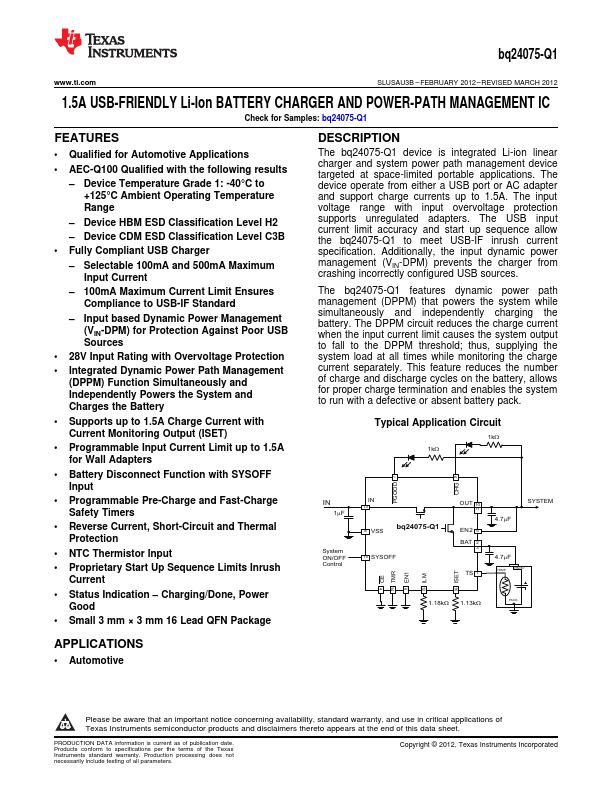
- Status Indication
- Charging/Done, Power Good
- Small 3 mm × 3 mm 16 Lead QFN Package
DESCRIPTION
The bq24075-Q1 device is integrated Li-ion linear charger and system power path management device targeted at space-limited portable applications. The device operate from either a USB port or AC adapter and support charge currents up to 1.5A. The input voltage range with input overvoltage protection supports unregulated adapters. The USB input current limit accuracy and start up sequence allow the bq24075-Q1 to meet USB-IF inrush current specification. Additionally, the input dynamic power management (VIN-DPM) prevents the charger from crashing incorrectly configured USB sources.
The bq24075-Q1 Features dynamic power path management (DPPM) that powers the system while simultaneously and independently charging the battery. The DPPM circuit reduces the charge current when the input current limit causes the system output to fall to the DPPM...