

Datasheet4U Logo Datasheet4U.com

74HC4094D - 8-stage shift-and-store bus register

Download the 74HC4094D datasheet PDF. This datasheet also covers the 74HC4094 variant, as both devices belong to the same 8-stage shift-and-store bus register family and are provided as variant models within a single manufacturer datasheet.

General Description

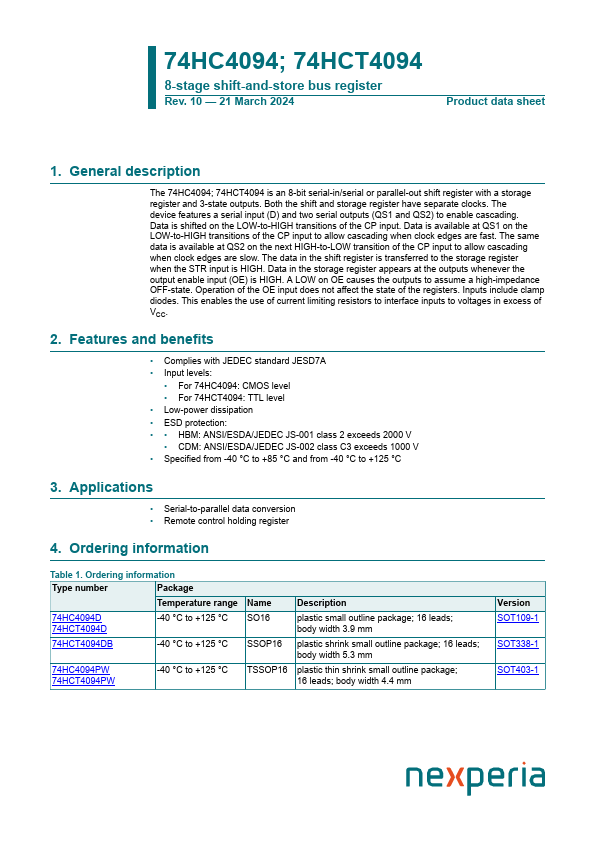
The 74HC4094; 74HCT4094 is an 8-bit serial-in/serial or parallel-out shift register with a storage register and 3-state outputs.

Both the shift and storage register have separate clocks.

Key Features

  • Complies with JEDEC standard JESD7A.
  • Input levels:.
  • For 74HC4094: CMOS level.
  • For 74HCT4094: TTL level.
  • Low-power dissipation.
  • ESD protection:.
  • HBM: ANSI/ESDA/JEDEC JS-001 class 2 exceeds 2000 V.
  • CDM: ANSI/ESDA/JEDEC JS-002 class C3 exceeds 1000 V.
  • Specified from -40 °C to +85 °C and from -40 °C to +125 °C 3.
📥 Download Datasheet

Note: The manufacturer provides a single datasheet file (74HC4094-nexperia.pdf) that lists specifications for multiple related part numbers.

Datasheet Details

Part number 74HC4094D
Manufacturer Nexperia
File Size 300.62 KB
Description 8-stage shift-and-store bus register
Datasheet download datasheet 74HC4094D Datasheet

Full PDF Text Transcription (Reference)

The following content is an automatically extracted verbatim text from the original manufacturer datasheet and is provided for reference purposes only.

View original datasheet text
74HC4094; 74HCT4094 8-stage shift-and-store bus register Rev. 10 — 21 March 2024 Product data sheet 1. General description The 74HC4094; 74HCT4094 is an 8-bit serial-in/serial or parallel-out shift register with a storage register and 3-state outputs. Both the shift and storage register have separate clocks. The device features a serial input (D) and two serial outputs (QS1 and QS2) to enable cascading. Data is shifted on the LOW-to-HIGH transitions of the CP input. Data is available at QS1 on the LOW-to-HIGH transitions of the CP input to allow cascading when clock edges are fast. The same data is available at QS2 on the next HIGH-to-LOW transition of the CP input to allow cascading when clock edges are slow.