Datasheet4U Logo Datasheet4U.com

74HCT175D - Quad D-type flip-flop

Download the 74HCT175D datasheet PDF. This datasheet also covers the 74HC175 variant, as both devices belong to the same quad d-type flip-flop family and are provided as variant models within a single manufacturer datasheet.

General Description

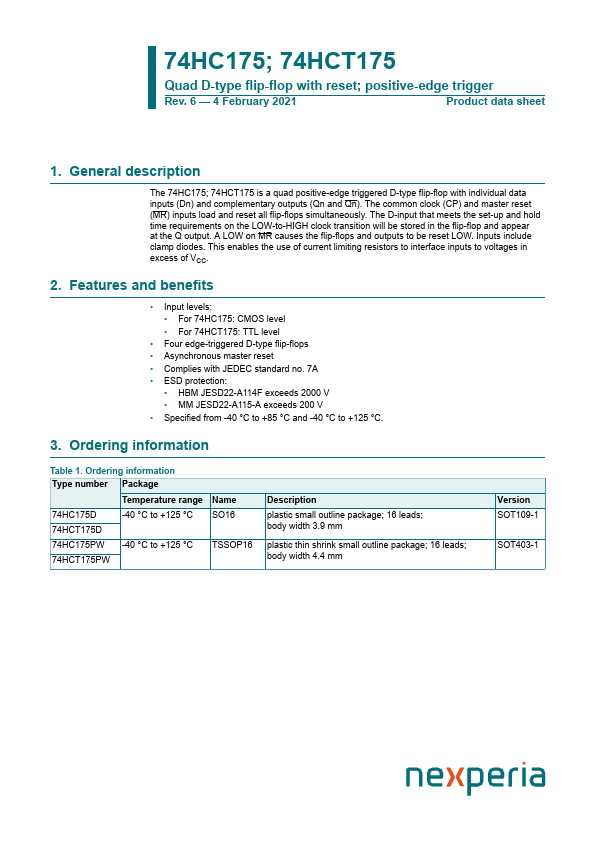
The 74HC175; 74HCT175 is a quad positive-edge triggered D-type flip-flop with individual data inputs (Dn) and complementary outputs (Qn and Qn).

The common clock (CP) and master reset (MR) inputs load and reset all flip-flops simultaneously.

Key Features

  • Input levels:.
  • For 74HC175: CMOS level.
  • For 74HCT175: TTL level.
  • Four edge-triggered D-type flip-flops.
  • Asynchronous master reset.
  • Complies with JEDEC standard no. 7A.
  • ESD protection:.
  • HBM JESD22-A114F exceeds 2000 V.
  • MM JESD22-A115-A exceeds 200 V.
  • Specified from -40 °C to +85 °C and -40 °C to +125 °C. 3. Ordering information Table 1. Ordering information Type number Package Temperature range Name 74H.

📥 Download Datasheet

Note: The manufacturer provides a single datasheet file (74HC175-nexperia.pdf) that lists specifications for multiple related part numbers.

Full PDF Text Transcription (Reference)

The following content is an automatically extracted verbatim text from the original manufacturer datasheet and is provided for reference purposes only.

View original datasheet text
74HC175; 74HCT175 Quad D-type flip-flop with reset; positive-edge trigger Rev. 6 — 4 February 2021 Product data sheet 1. General description The 74HC175; 74HCT175 is a quad positive-edge triggered D-type flip-flop with individual data inputs (Dn) and complementary outputs (Qn and Qn). The common clock (CP) and master reset (MR) inputs load and reset all flip-flops simultaneously. The D-input that meets the set-up and hold time requirements on the LOW-to-HIGH clock transition will be stored in the flip-flop and appear at the Q output. A LOW on MR causes the flip-flops and outputs to be reset LOW. Inputs include clamp diodes. This enables the use of current limiting resistors to interface inputs to voltages in excess of VCC. 2.