CC2431
CC2431 is System-on-Chip for 2.4 GHz ZigBee / IEEE 802.15.4 manufactured by Chipcon.
Description
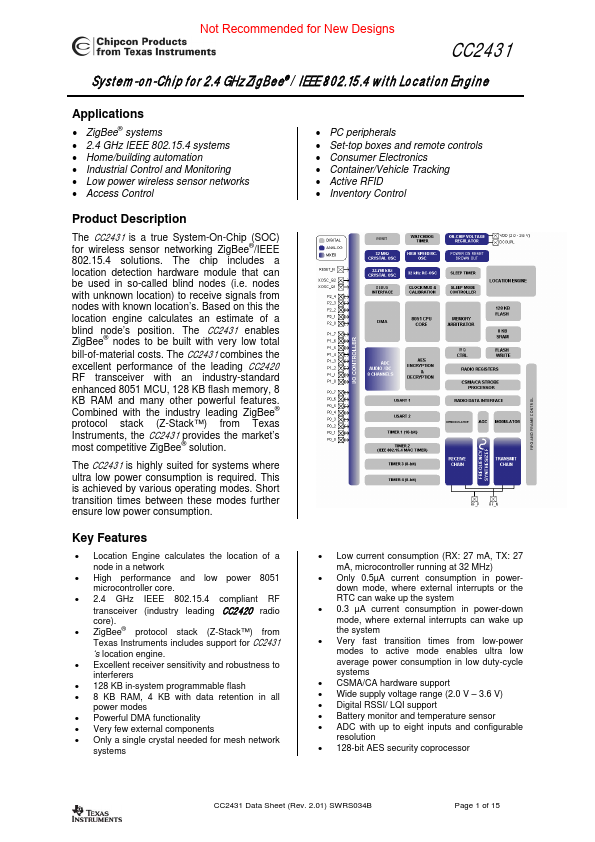
The CC2431 is a true System-On-Chip (SOC) for wireless sensor networking Zig Bee®/IEEE 802.15.4 solutions. The chip includes a location detection hardware module that can be used in so-called blind nodes (i.e. nodes with unknown location) to receive signals from nodes with known location’s. Based on this the location engine calculates an estimate of a blind node’s position. The CC2431 enables Zig Bee® nodes to be built with very low total bill-of-material costs. The CC2431 bines the excellent performance of the leading CC2420 RF transceiver with an industry-standard enhanced 8051 MCU, 128 KB flash memory, 8 KB RAM and many other powerful features
. bined with the industry leading Zig Bee® protocol stack (Z-Stack™) from Texas Instruments, the CC2431 provides the market’s most petitive Zig Bee® solution.
The CC2431 is highly suited for systems where ultra low power consumption is required. This is achieved by various operating modes. Short transition times between these modes further ensure low power consumption.
Key Features
- Location Engine calculates the location of a node in a network
- High performance and low power 8051 microcontroller core.
- 2.4 GHz IEEE 802.15.4 pliant RF transceiver (industry leading CC2420 radio core).
- Zig Bee® protocol stack (Z-Stack™) from
Texas Instruments includes support for CC2431 ‘s location engine.
- Excellent receiver sensitivity and robustness to interferers
- 128 KB in-system programmable flash
- 8 KB RAM, 4 KB with data retention in all power modes
- Powerful DMA functionality
- Very few external ponents
- Only a single crystal needed for mesh network systems
- PC peripherals
- Set-top boxes and remote controls
- Consumer Electronics
- Container/Vehicle Tracking
- Active RFID
- Inventory Control
- Low current consumption (RX: 27 m A, TX: 27 m A, microcontroller running at 32 MHz)
- Only 0.5µA current consumption in powerdown mode, where external interrupts or the RTC can wake up the system
- 0.3 µA current consumption...