IS61NP25632
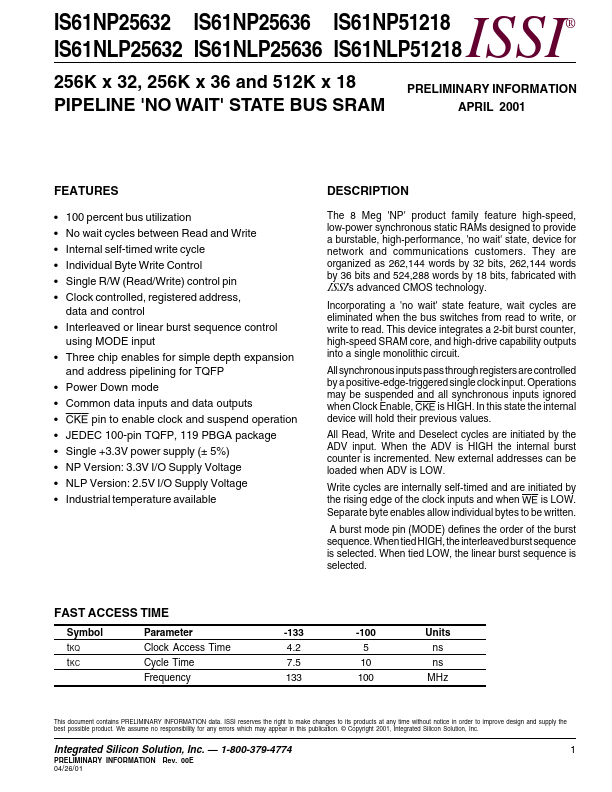
IS61NP25632 is 256K x 32/ 256K x 36 and 512K x 18 PIPELINE NO WAIT STATE BUS SRAM manufactured by ISSI.
- Part of the IS6 comparator family.
- Part of the IS6 comparator family.
FEATURES
- -
- -
- -
- -
- -
- -
- -
- - 100 percent bus utilization No wait cycles between Read and Write Internal self-timed write cycle Individual Byte Write Control Single R/W (Read/Write) control pin Clock controlled, registered address, data and control Interleaved or linear burst sequence control using MODE input Three chip enables for simple depth expansion and address pipelining for TQFP Power Down mode mon data inputs and data outputs CKE pin to enable clock and suspend operation JEDEC 100-pin TQFP, 119 PBGA package Single +3.3V power supply (± 5%) NP Version: 3.3V I/O Supply Voltage NLP Version: 2.5V I/O Supply Voltage Industrial temperature available
DESCRIPTION
The 8 Meg 'NP' product family feature high-speed, low-power synchronous static RAMs designed to provide a burstable, high-performance, 'no wait' state, device for network and munications customers. They are organized as 262,144 words by 32 bits, 262,144 words by 36 bits and 524,288 words by 18 bits, fabricated with ISSI's advanced CMOS technology. Incorporating a 'no wait' state feature
, wait cycles are eliminated when the bus switches from read to write, or write to read. This device integrates a 2-bit burst counter, high-speed SRAM core, and high-drive capability outputs into a single monolithic circuit. All synchronous inputs pass through registers are controlled by a positive-edge-triggered single clock input. Operations may be suspended and all synchronous inputs ignored when Clock Enable, CKE is HIGH. In this state the internal device will hold their previous values. All Read, Write and Deselect cycles are initiated by the ADV input. When the ADV is HIGH the internal burst counter is incremented. New external addresses can be loaded when ADV is LOW. Write cycles are internally self-timed and are initiated by the rising edge of the clock inputs and when WE is LOW. Separate byte enables allow individual bytes to be written. A burst mode pin (MODE) defines the order of the burst sequence....