Datasheet4U Logo Datasheet4U.com

NCP1395B - High Performance Resonant Mode Controller

Download the NCP1395B datasheet PDF. This datasheet also covers the NCP1395A variant, as both devices belong to the same high performance resonant mode controller family and are provided as variant models within a single manufacturer datasheet.

General Description

Pin No.

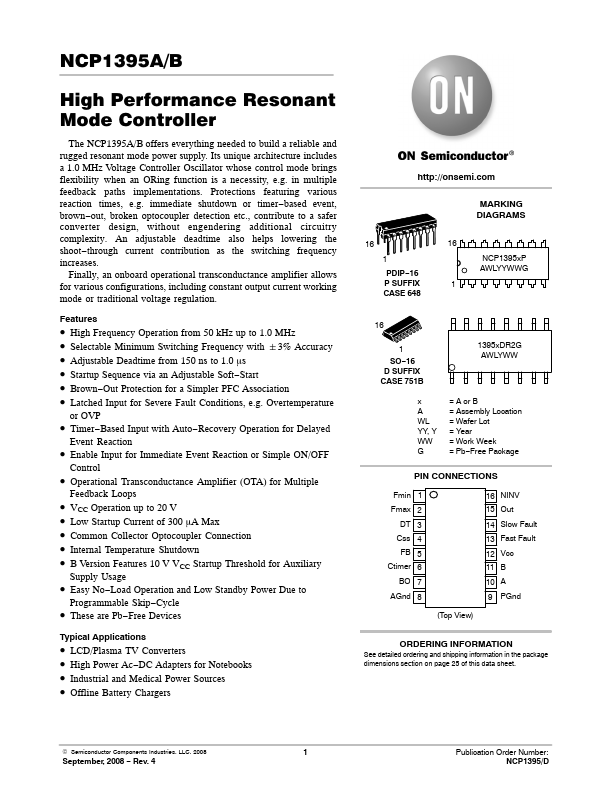
Start 5 FB Feedback 6 Ctimer Timer Duration 7 BO Brown Out 8 Agnd Analog Ground 9 Pgnd Power Ground 10 A Low Side Output 11 B High Side Output 12 Vcc Supplies the Con

Key Features

  • High Frequency Operation from 50 kHz up to 1.0 MHz.
  • Selectable Minimum Switching Frequency with "3% Accuracy.
  • Adjustable Deadtime from 150 ns to 1.0 ms.
  • Startup Sequence via an Adjustable Soft.
  • Start.
  • Brown.
  • Out Protection for a Simpler PFC Association.
  • Latched Input for Severe Fault Conditions, e. g. Overtemperature or OVP.
  • Timer.
  • Based Input with Auto.
  • Recovery Operation for Delayed Event Reaction.

📥 Download Datasheet

Note: The manufacturer provides a single datasheet file (NCP1395A_ONSemiconductor.pdf) that lists specifications for multiple related part numbers.

Datasheet Details

Part number NCP1395B
Manufacturer onsemi
File Size 343.84 KB
Description High Performance Resonant Mode Controller
Datasheet download datasheet NCP1395B Datasheet

Full PDF Text Transcription (Reference)

The following content is an automatically extracted verbatim text from the original manufacturer datasheet and is provided for reference purposes only.

View original datasheet text
NCP1395A/B High Performance Resonant Mode Controller The NCP1395A/B offers everything needed to build a reliable and rugged resonant mode power supply. Its unique architecture includes a 1.0 MHz Voltage Controller Oscillator whose control mode brings flexibility when an ORing function is a necessity, e.g. in multiple feedback paths implementations. Protections featuring various reaction times, e.g. immediate shutdown or timer−based event, brown−out, broken optocoupler detection etc., contribute to a safer converter design, without engendering additional circuitry complexity. An adjustable deadtime also helps lowering the shoot−through current contribution as the switching frequency increases.