NCT24
NCT24 is Low Cost Single Trip Point Temperature Sensor manufactured by onsemi.
- Part of the NCT22 comparator family.
- Part of the NCT22 comparator family.
feature low supply current making them suitable for many portable applications.
The devices are offered in surface mount packages.
Features
- Temperature Set Point Easily Programs with a Single External
Resistor
- Operates with 2.7 V Power Supply (NCT24)
- Small SOIC Package
- Cost Effective
Applications
- Power Supply Over- Temperature Detection
- Consumer Electronics
- Fire/Heat Detection
- UPSs, Amplifiers, Motors
- CPU Thermal Management in PCs
+
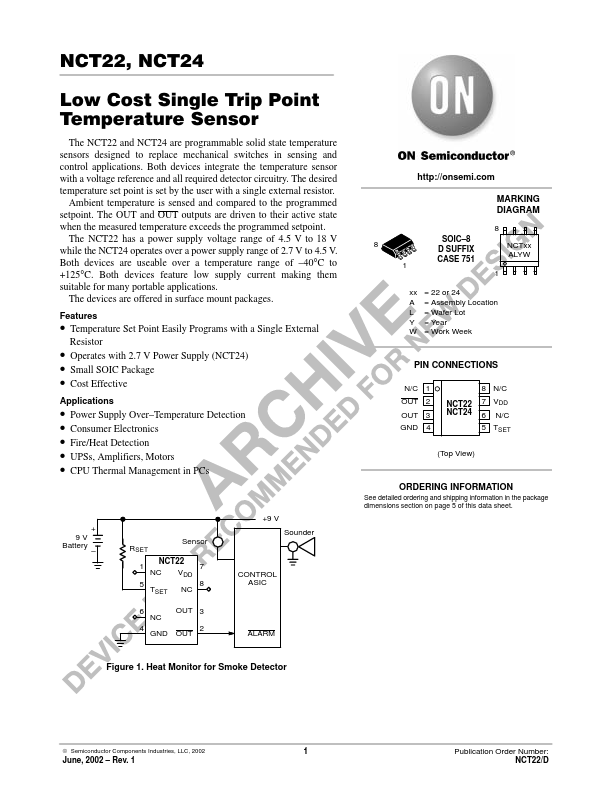
9V Battery
- RSET
Sensor
1 NCT22 7 NC VDD
5 TSET
8 NC
6 OUT 3 NC
4 GND OUT 2
+9 V Sounder
CONTROL ASIC
ALARM http://onsemi.
MARKING DIAGRAM
8 1
SOIC- 8 D SUFFIX CASE 751
NCTxx ALYW
1 xx = 22 or 24 A = Assembly Location L = Wafer Lot Y = Year W = Work Week
PIN CONNECTIONS
N/C 1 OUT 2 OUT 3 GND 4
NCT22 NCT24
8 N/C 7 VDD 6 N/C 5 TSET
(Top View)
ORDERING INFORMATION
See detailed ordering and shipping information in the package dimensions section on page 5 of this data sheet.
Figure 1. Heat Monitor for Smoke...