

IDT72251
IDT72251 is CMOS SyncFIFO manufactured by Renesas.
- Part of the IDT72421 comparator family.
FEATURES
:
- 64 x 9-bit organization (IDT72421)
- 256 x 9-bit organization (IDT72201)
- 512 x 9-bit organization (IDT72211)
- 1,024 x 9-bit organization (IDT72221)
- 2,048 x 9-bit organization (IDT72231)
- 4,096 x 9-bit organization (IDT72241)
- 8,192 x 9-bit organization (IDT72251)
- 10 ns read/write cycle time
- Read and Write Clocks can be independent
- Dual-Ported zero fall-through time architecture
- Empty and Full Flags signal FIFO status
- Programmable Almost-Empty and Almost-Full flags can be set to any depth
- Programmable Almost-Empty and Almost-Full flags default to
Empty+7, and Full-7, respectively
- Output enable puts output data bus in high-impedance state
- Advanced submicron CMOS technology
- Available in the 32-pin plastic leaded chip carrier (PLCC) and
32-pin Thin Quad Flat Pack (TQFP)
- For through-hole product please see the IDT72420/72200/72210/
72220/72230/72240 data sheet
- Industrial temperature range (- 40°C to +85°C) is available
- Green parts available, see ordering information
DESCRIPTION
:
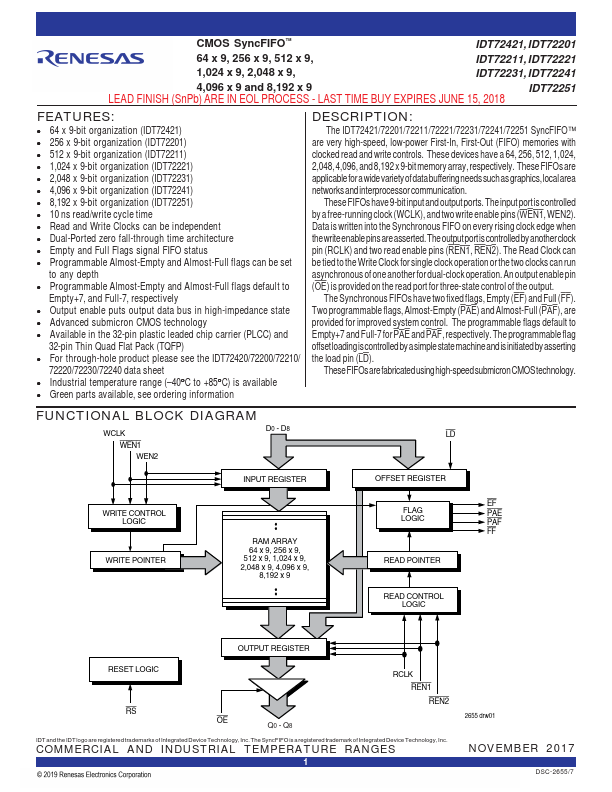
The IDT72421/72201/72211/72221/72231/72241/72251 Sync FIFO™ are very high-speed, low-power First-In, First-Out (FIFO) memories with clocked read and write controls. These devices have a 64, 256, 512, 1,024, 2,048, 4,096, and 8,192 x 9-bit memory array, respectively. These FIFOs are applicable for a wide variety of data buffering needs such as graphics, local area networks and interprocessor munication.
These FIFOs have 9-bit input and output ports. The input port is controlled by a free-running clock (WCLK), and two write enable pins (WEN1, WEN2). Data is written into the Synchronous FIFO on every rising clock edge when the write enable pins are asserted. The output port is controlled by another clock pin (RCLK) and two read enable pins (REN1, REN2). The Read Clock can be tied to the Write Clock for single clock operation or the two clocks can run asynchronous of one another for dual-clock operation. An output enable pin (OE) is provided on the read port...