SN74AUP1G79
SN74AUP1G79 is Low-Power Single Positive-Edge-Triggered D-Type Flip-Flop manufactured by Texas Instruments.
Features
- 1 Available in the Texas Instruments Nano Star™ Package
- Low Static-Power Consumption: ICC = 0.9 µA Maximum
- Low Dynamic-Power Consumption: Cpd = 3 p F Typical at 3.3 V
- Low Input Capacitance: Ci = 1.5 p F Typical
- Low Noise: Overshoot and Undershoot < 10% of VCC
- Ioff Supports Partial Power-Down-Mode Operation
- Input Hysteresis Allows Slow Input Transition and
Better Switching Noise Immunity at the Input (Vhys = 250 m V Typical at 3.3 V)
- Wide Operating VCC Range of 0.8 V to 3.6 V
- Optimized for 3.3-V Operation
- 3.6-V I/O Tolerant to Support Mixed-Mode Signal Operation
- tpd = 4 ns Maximum at 3.3 V
- Suitable for Point-to-Point Applications
- Latch-Up Performance Exceeds 100 m A Per JESD 78, Class II
- ESD Performance Tested Per JESD 22
- 2000-V Human-Body Model
(A114-B, Class II)
- 1000-V Charged-Device Model (C101)
2 Applications
- Barcode Scanner
- Cable Solutions
- E-Book
- Embedded PC
- Field Transmitter: Temperature or Pressure
Sensor
- Fingerprint Biometrics
- HVAC: Heating, Ventilating, and Air Conditioning
- Network-Attached Storage (NAS)
- Server Motherboard and PSU
- Software Defined Radio (SDR)
- TV: High-Definition (HDTV), LCD, and Digital
- Video munications System
- Wireless Data Access Card, Headset, Keyboard,
Mouse, and LAN Card
3 Description
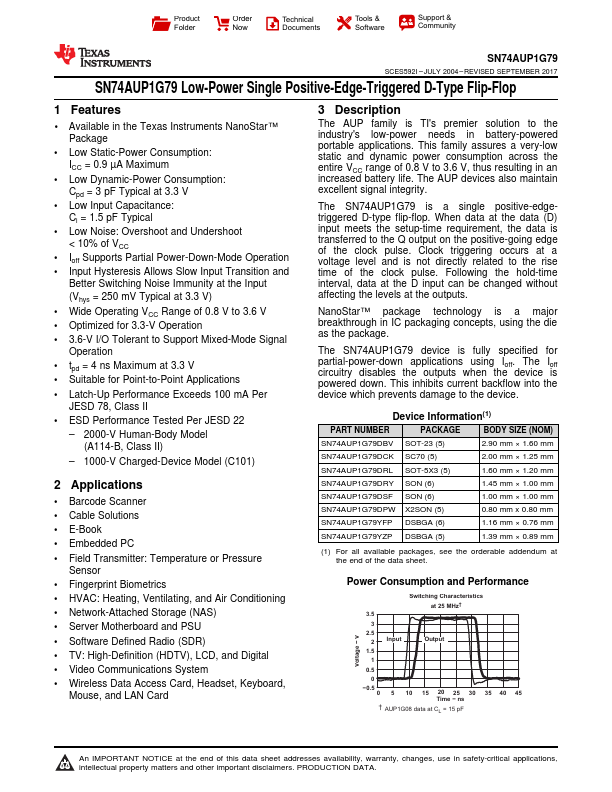
The AUP family is TI's premier solution to the industry's low-power needs in battery-powered portable applications. This family assures a very-low static and dynamic power consumption across the entire VCC range of 0.8 V to 3.6 V, thus resulting in an increased battery life. The AUP devices also maintain excellent signal integrity.
The SN74AUP1G79 is a single positive-edgetriggered D-type flip-flop. When data at the data (D) input meets the setup-time requirement, the data is transferred to the Q output on the positive-going edge of the clock pulse. Clock triggering occurs at a voltage level and is not directly related to the rise time of the clock pulse. Following the hold-time interval, data...