

Datasheet4U Logo Datasheet4U.com

74AHCT273-Q100 - Octal D-type flip-flop

Download the 74AHCT273-Q100 datasheet PDF. This datasheet also covers the 74AHC273-Q100 variant, as both devices belong to the same octal d-type flip-flop family and are provided as variant models within a single manufacturer datasheet.

General Description

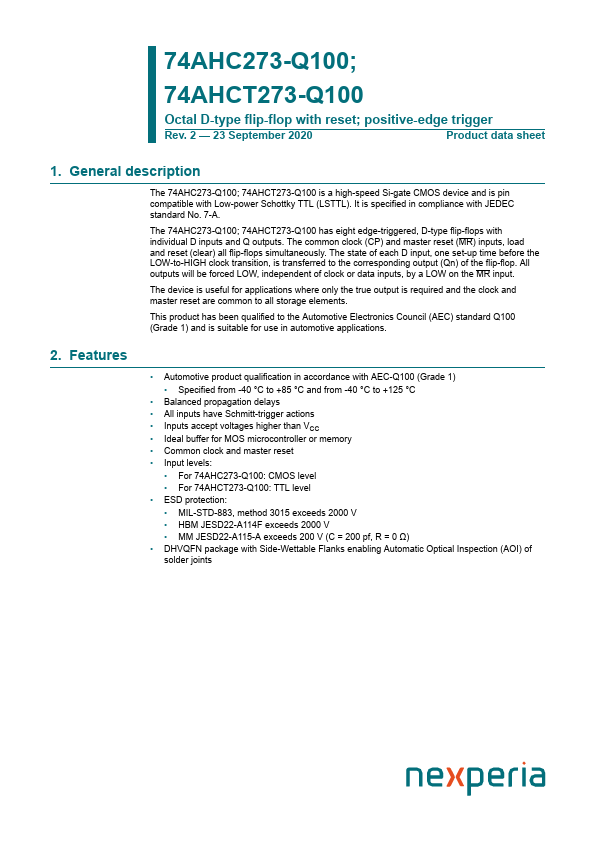
The 74AHC273-Q100; 74AHCT273-Q100 is a high-speed Si-gate CMOS device and is pin compatible with Low-power Schottky TTL (LSTTL).

It is specified in compliance with JEDEC standard No.

7-A.

Key Features

  • Automotive product qualification in accordance with AEC-Q100 (Grade 1).
  • Specified from -40 °C to +85 °C and from -40 °C to +125 °C.
  • Balanced propagation delays.
  • All inputs have Schmitt-trigger actions.
  • Inputs accept voltages higher than VCC.
  • Ideal buffer for MOS microcontroller or memory.
  • Common clock and master reset.
  • Input levels:.
  • For 74AHC273-Q100: CMOS level.
  • For 74AHCT273-Q100: TTL level.
  • E.

📥 Download Datasheet

Note: The manufacturer provides a single datasheet file (74AHC273-Q100-nexperia.pdf) that lists specifications for multiple related part numbers.

Full PDF Text Transcription for 74AHCT273-Q100 (Reference)

Note: Below is a high-fidelity text extraction (approx. 800 characters) for 74AHCT273-Q100. For precise diagrams, and layout, please refer to the original PDF.

74AHC273-Q100; 74AHCT273-Q100 Octal D-type flip-flop with reset; positive-edge trigger Rev. 2 — 23 September 2020 Product data sheet 1. General description The 74AHC273-Q...

View more extracted text
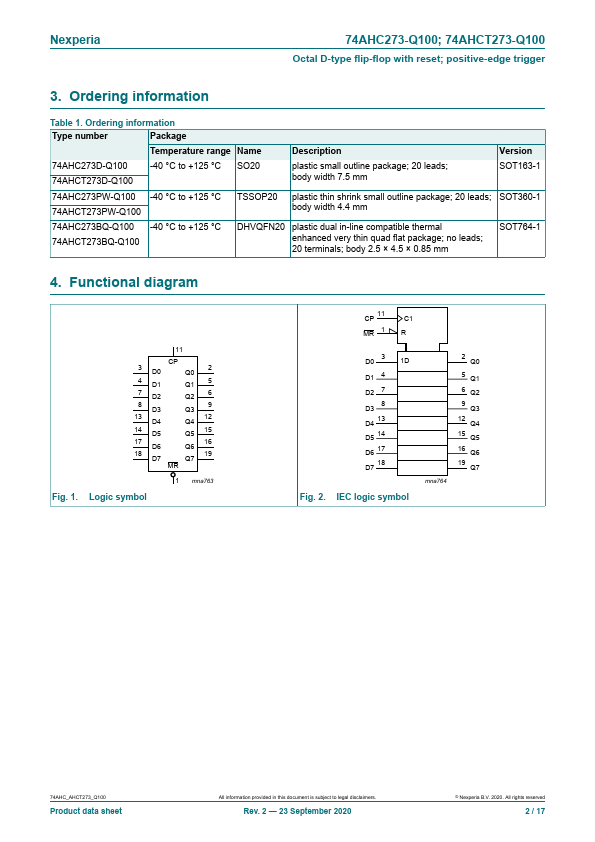
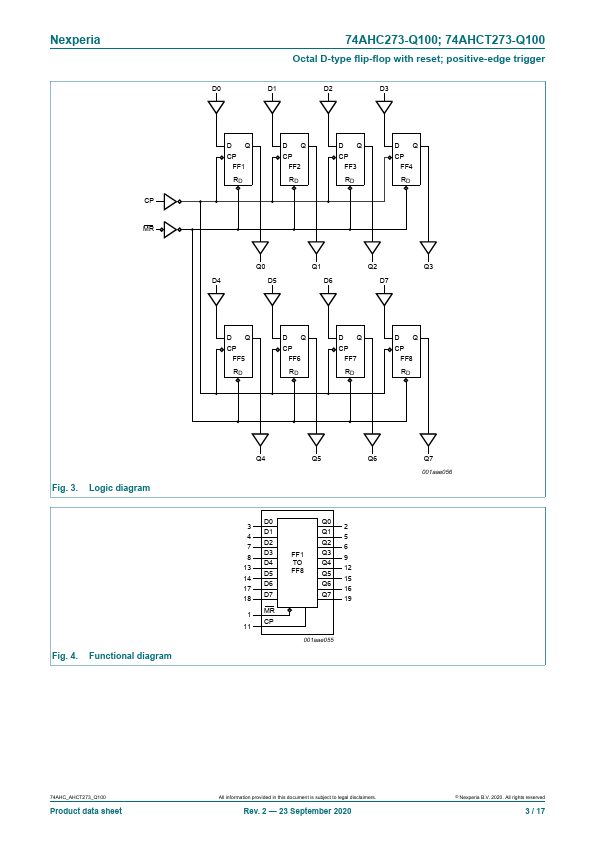
eptember 2020 Product data sheet 1. General description The 74AHC273-Q100; 74AHCT273-Q100 is a high-speed Si-gate CMOS device and is pin compatible with Low-power Schottky TTL (LSTTL). It is specified in compliance with JEDEC standard No. 7-A. The 74AHC273-Q100; 74AHCT273-Q100 has eight edge-triggered, D-type flip-flops with individual D inputs and Q outputs. The common clock (CP) and master reset (MR) inputs, load and reset (clear) all flip-flops simultaneously. The state of each D input, one set-up time before the LOW-to-HIGH clock transition, is transferred to the corresponding output (Qn) of the flip-flop.