Datasheet4U Logo Datasheet4U.com

MAX15109 - Current-Mode Synchronous Step-Down Switching Regulator

Datasheet Summary

Description

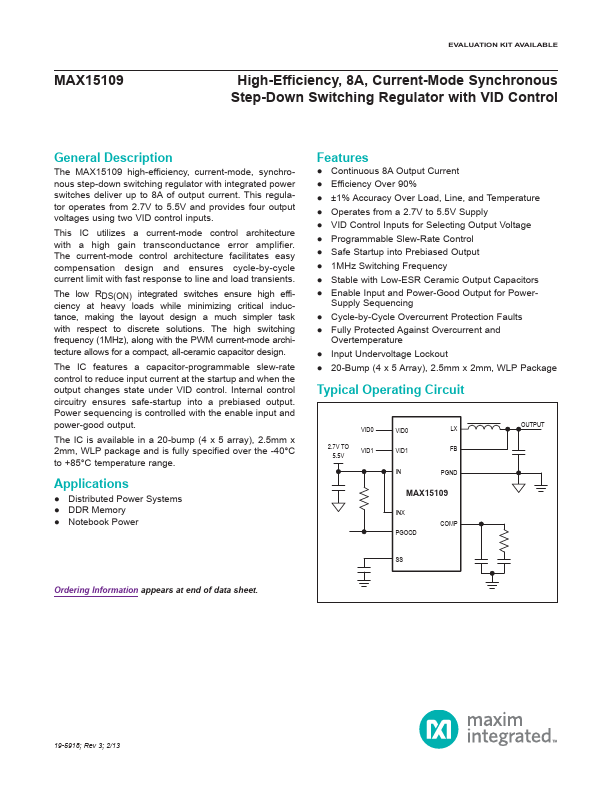
The MAX15109 high-efficiency, current-mode, synchronous step-down switching regulator with integrated power switches deliver up to 8A of output current.

This regulator operates from 2.7V to 5.5V and provides four output voltages using two VID control inputs.

Features

  • a capacitor-programmable slew-rate control to reduce input current at the startup and when the output changes state under VID control. Internal control circuitry ensures safe-startup into a prebiased output. Power sequencing is controlled with the enable input and power-good output. The IC is available in a 20-bump (4 x 5 array), 2.5mm x 2mm, WLP package and is fully specified over the -40NC to +85NC temperature range. Features S Continuous 8A Output Current S Efficiency Over 90% S ±1% Accur.

📥 Download Datasheet

Datasheet preview – MAX15109

Datasheet Details

Part number MAX15109
Manufacturer Maxim Integrated Products
File Size 877.72 KB
Description Current-Mode Synchronous Step-Down Switching Regulator
Datasheet download datasheet MAX15109 Datasheet
Additional preview pages of the MAX15109 datasheet.
Other Datasheets by Maxim Integrated Products

Full PDF Text Transcription

Click to expand full text
19-5918; Rev 0; 6/11 High-Efficiency, 8A, Current-Mode Synchronous Step-Down Switching Regulator with VID Control General Description The MAX15109 high-efficiency, current-mode, synchronous step-down switching regulator with integrated power switches deliver up to 8A of output current. This regulator operates from 2.7V to 5.5V and provides four output voltages using two VID control inputs. This IC utilizes a current-mode control architecture with a high gain transconductance error amplifier. The current-mode control architecture facilitates easy compensation design and ensures cycle-by-cycle current limit with fast response to line and load transients. This regulator offers skip-mode functionality to reduce current consumption and achieve a higher efficiency at light loads.
Published: |