Datasheet4U Logo Datasheet4U.com

54121 - Monostable Multivibrator

Datasheet Summary

Description

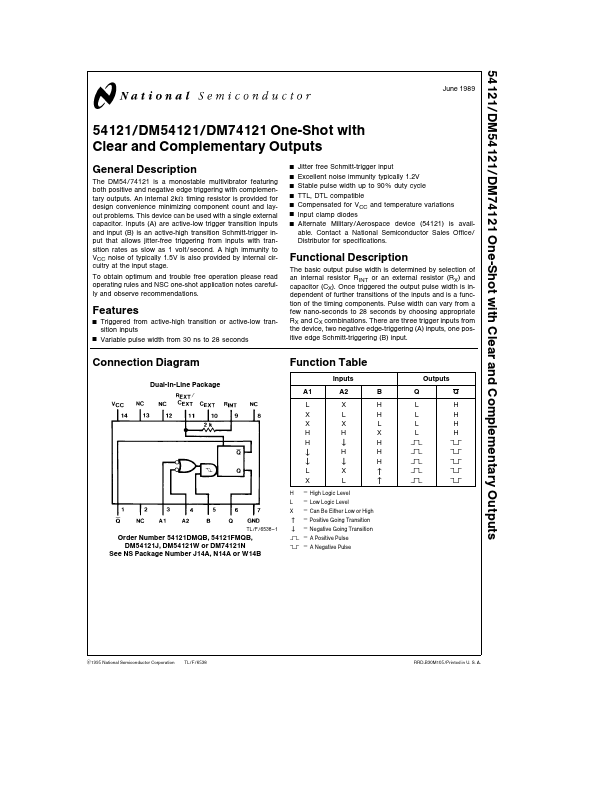
The DM54 74121 is a monostable multivibrator featuring both positive and negative edge triggering with complementary outputs An internal 2kX timing resistor is provided for design convenience minimizing component count and layout problems This device can be used with a single external capacitor Inpu

Features

  • Y Y Triggered from active-high transition or active-low transition inputs Variable pulse width from 30 ns to 28 seconds Connection Diagram Dual-In-Line Package Function Table Inputs A1 L X X H H A2 X L X H B H H L X H H H Q L L L L Outputs Q H H H H v H v v L X H L X TL F 6538.
  • 1 v X L u u e High Logic Level e Low Logic Level e Can Be Either Low or High e Positive Going Transition e Negative Going Transition e A Positive Pulse e A Negative Pulse u v Order Number 54121DMQB 5412.

📥 Download Datasheet

Datasheet preview – 54121

Datasheet Details

Part number 54121
Manufacturer National Semiconductor
File Size 128.44 KB
Description Monostable Multivibrator
Datasheet download datasheet 54121 Datasheet
Additional preview pages of the 54121 datasheet.
Other Datasheets by National Semiconductor

Full PDF Text Transcription

Click to expand full text
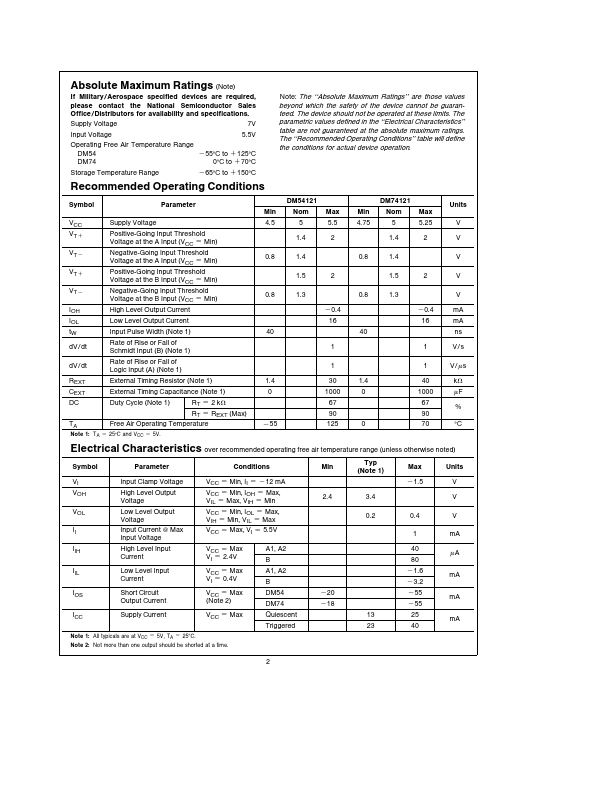
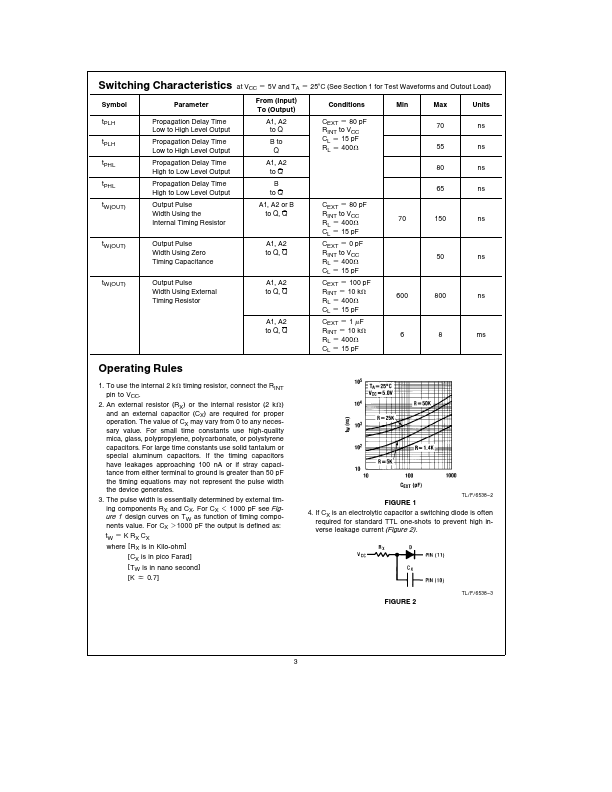
54121 DM54121 DM74121 One-Shot with Clear and Complementary Outputs June 1989 54121 DM54121 DM74121 One-Shot with Clear and Complementary Outputs General Description The DM54 74121 is a monostable multivibrator featuring both positive and negative edge triggering with complementary outputs An internal 2kX timing resistor is provided for design convenience minimizing component count and layout problems This device can be used with a single external capacitor Inputs (A) are active-low trigger transition inputs and input (B) is an active-high transition Schmitt-trigger input that allows jitter-free triggering from inputs with transition rates as slow as 1 volt second A high immunity to VCC noise of typically 1 5V is also provided by internal circuitry at the input stage To obtain optimum an
Published: |