Datasheet4U Logo Datasheet4U.com

LM2630 - Synchronous Step-Down Power Supply Controller

Datasheet Summary

Description

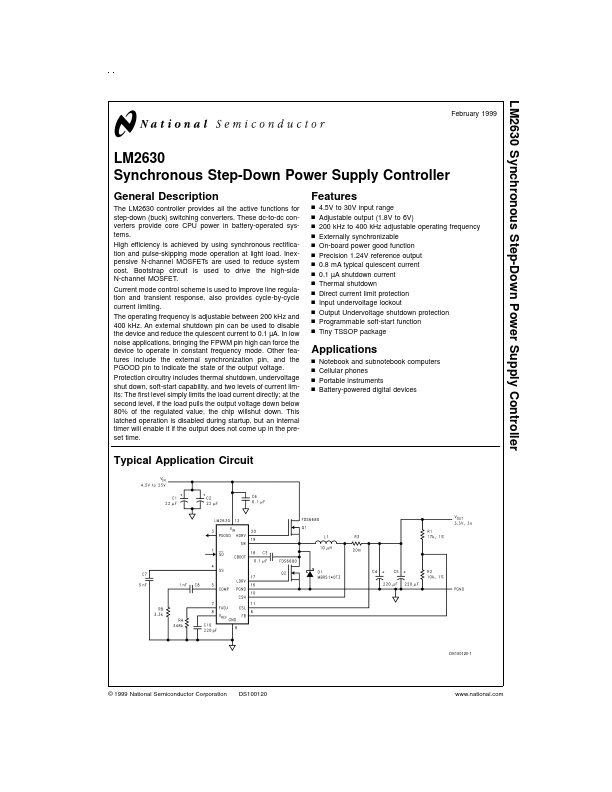
The LM2630 controller provides all the active functions for step-down (buck) switching converters.

These dc-to-dc converters provide core CPU power in battery-operated systems.

High efficiency is achieved by using synchronous rectification and pulse-skipping mode operation at light load.

Features

  • include the external synchronization pin, and the PGOOD pin to indicate the state of the output voltage. Protection circuitry includes thermal shutdown, undervoltage shut down, soft-start capability, and two levels of current limits: The first level simply limits the load current directly; at the second level, if the load pulls the output voltage down below 80% of the regulated value, the chip willshut down. This latched operation is disabled during startup, but an internal timer will enable it.

📥 Download Datasheet

Datasheet preview – LM2630

Datasheet Details

Part number LM2630
Manufacturer National Semiconductor
File Size 265.95 KB
Description Synchronous Step-Down Power Supply Controller
Datasheet download datasheet LM2630 Datasheet
Additional preview pages of the LM2630 datasheet.
Other Datasheets by National Semiconductor

Full PDF Text Transcription

Click to expand full text
LM2630 Synchronous Step-Down Power Supply Controller February 1999 LM2630 Synchronous Step-Down Power Supply Controller General Description The LM2630 controller provides all the active functions for step-down (buck) switching converters. These dc-to-dc converters provide core CPU power in battery-operated systems. High efficiency is achieved by using synchronous rectification and pulse-skipping mode operation at light load. Inexpensive N-channel MOSFETs are used to reduce system cost. Bootstrap circuit is used to drive the high-side N-channel MOSFET. Current mode control scheme is used to improve line regulation and transient response, also provides cycle-by-cycle current limiting. The operating frequency is adjustable between 200 kHz and 400 kHz.
Published: |