AT90SP0801
AT90SP0801 is Secure Signature Generation Chip manufactured by Atmel.
Features
- -
- -
- -
- -
Secure putation of Public Key Signatures Secure Storage and Decryption of Symmetric Keys On-chip Cache for Frequently Used Keys SMBus munications Port On-board Public Key putation Engine and Microprocessor Physical and Logical Security Measures to Inhibit Attacks 20-lead SOIC Package, 0°C to +70°C Operating Range 3.3V ±10% Supply Voltage
Description
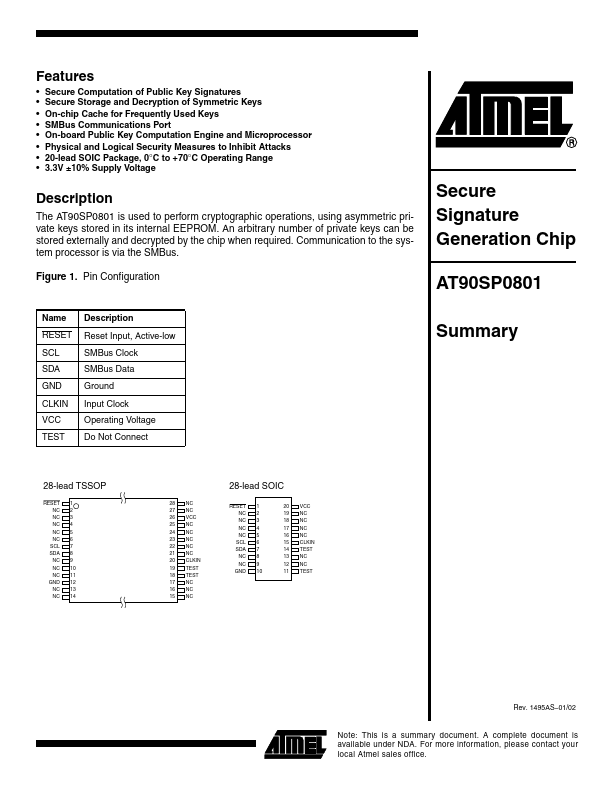
The AT90SP0801 is used to perform cryptographic operations, using asymmetric private keys stored in its internal EEPROM. An arbitrary number of private keys can be stored externally and decrypted by the chip when required. munication to the system processor is via the SMBus. Figure 1. Pin Configuration
Secure Signature Generation Chip AT90SP0801 Summary
Name RESET SCL SDA GND CLKIN VCC TEST
Description
Reset Input, Active-low SMBus Clock SMBus Data Ground Input Clock Operating Voltage Do Not Connect
28-lead TSSOP
RESET NC NC NC NC NC SCL SDA NC NC NC GND NC NC 1 2 3 4 5 6 7 8 9 10 11 12 13 14 28 27 26 25 24 23 22 21 20 19 18 17 16 15 NC NC VCC NC NC NC NC NC CLKIN TEST TEST NC NC NC
28-lead SOIC
RESET NC NC NC NC SCL SDA NC NC GND 1 2 3 4 5 6 7 8 9 10 20 19 18 17 16 15 14 13 12 11 VCC NC NC NC NC CLKIN TEST NC NC TEST
Rev. 1495AS- 01/02
Note: This is a summary document. A plete document is available under NDA. For more information, please contact your local Atmel sales office.
Figure 2. Block Diagram
EEPROM Registers
Hardware Key Private Key Password User Key Buffer 0 Private Key Password, Mode CRC Tag User Key Buffer 1 Private Key Password, Mode CRC Tag
Data
I/O Buffer
SMBus 8/16-bit Crypto Data Buffer mands
AVR µp CLKIN RESET Program Memory
Public Key Crypto Engine
Key:
Control: Data:
Other Configuration Registers: LOCK, STATUS ERROR, VERS FAILCNT, CONFIG
1495AS- 01/02
Serial Interface
Data is transferred to or from the I/O buffer on the chip using the SMBus interface, in a manner similar but not identical to that of standard two-wire serial EEPROMs....