ADIS16204
ADIS16204 is Programmable Dual Axis Digital Accelerometer and Impact Sensor manufactured by Analog Devices.
..
Preliminary Technical Data
Features
Dual-axis impact sensing Dual-axis acceleration sensing, +70g, +35g 14-bit resolution 17.1 mg/LSB, 8.55mg/LSB sensitivity Impact peak-level sample and hold Programmable Event Recorder 400Hz double-pole Bessel sensor response 12-bit digital temperature sensor output Digitally controlled sensitivity and bias Digitally controlled sample rate, up to 4096 SPS Dual alarm settings with programmable threshold limits Auxiliary digital I/O Digitally activated self test Digitally activated low power mode SPI®-patible serial interface Auxiliary 12-bit ADC input and DAC output Single-supply operation: 3.0 V to +3.6 V 3500 g powered shock survivability
Programmable Dual Axis Digital Accelerometer and Impact Sensor ADIS16204
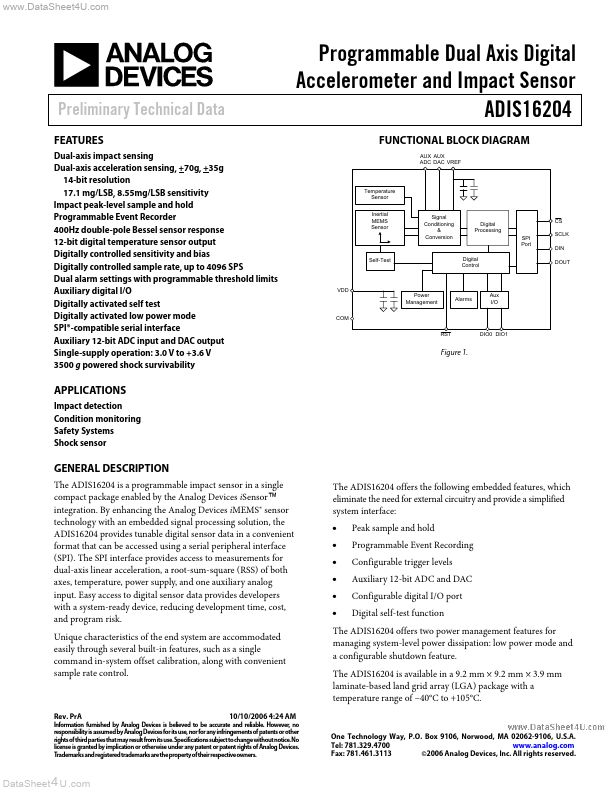
FUNCTIONAL BLOCK DIAGRAM
AUX AUX ADC DAC VREF
Temperature Sensor Inertial MEMS Sensor
Signal Conditioning & Conversion
Digital Processing SPI Port Digital Control
CS SCLK DIN DOUT
Self-Test
Power Management
Alarms
Aux I/O
RST DIO0 DIO1
Figure 1.
APPLICATIONS
Impact detection Condition monitoring Safety Systems Shock sensor
GENERAL DESCRIPTION
The ADIS16204 is a programmable impact sensor in a single pact package enabled by the Analog Devices i Sensor™ integration. By enhancing the Analog Devices i MEMS® sensor technology with an embedded signal processing solution, the ADIS16204 provides tunable digital sensor data in a convenient format that can be accessed using a serial peripheral interface (SPI). The SPI interface provides access to measurements for dual-axis linear acceleration, a root-sum-square (RSS) of both axes, temperature, power supply, and one auxiliary analog input. Easy access to digital sensor data provides developers with a system-ready device, reducing development time, cost, and program risk. Unique characteristics of the end system are acmodated easily through several built-in Features
, such as a single mand in-system offset calibration, along with...