ADN2820
ADN2820 is 10.7 Gbps / 3.3V / Low Noise / TIA manufactured by Analog Devices.
FEATURES
Technology: high performance Si Ge Bandwidth: 9 GHz Input noise current density: 1.0 µA Optical sensitivity:
- 19.3 d Bm Differential transimpedance: 5000 V/A Power dissipation: 200 m W Input current overload: 2.8 m A p-p Linear input range: 0.15 m A p-p Output resistance: 50 Ω/side Output offset adjustment range: 240 m V Average input power monitor: 1 V/m A Die size: 0.87 mm × 1.06 mm
PRODUCT DESCRIPTION
The ADN2820 is a pact, high performance, 3.3 V power supply Si Ge transimpedance amplifier (TIA) optimized for 10 Gbps Metro-Access and Ethernet systems. It is a single chip solution for detecting photodiode current with a differential output voltage. The ADN2820 features low input referred noise current and high output transimpedance gain, capable of driving a typical CDR or transceiver directly. A POWMON output is provided for input average power monitoring and alarm generation. Low nominal output offset enables dc output coupling to 3.3 V circuits. The OFFSET control input enables output slice level adjustment for asymmetric input signals. The ADN2820 operates with a 3.3 V power supply and is available in die form.
APPLICATIONS
10.7 Gbps optical modules SONET/SDH OC-192/STM-64 and 10 Gb E receivers, transceivers, and transponders
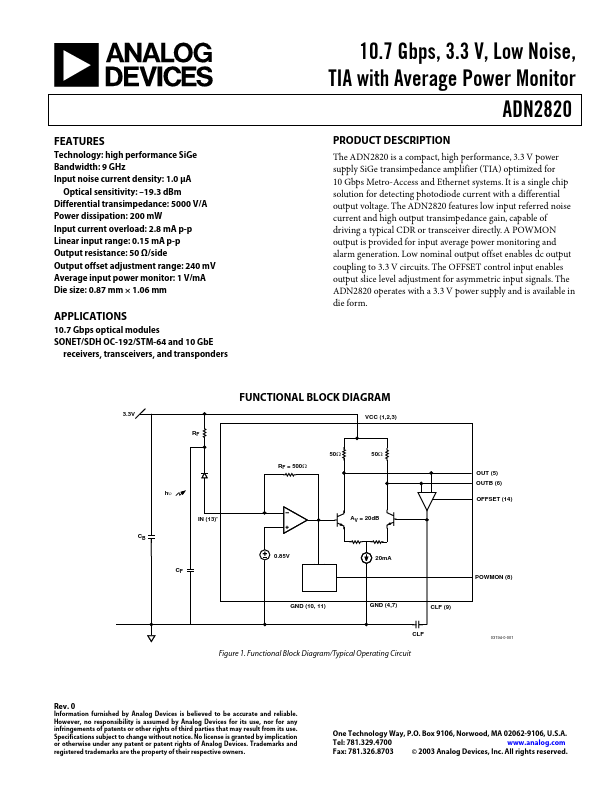
FUNCTIONAL BLOCK DIAGRAM
3.3V RF 50Ω RF = 500Ω OUT (5) OUTB (6) hυ OFFSET (14) IN (13)' CB 0.85V CF POWMON (8) 20m A AV = 20d B 50Ω VCC (1,2,3)
GND (10, 11)
GND (4,7)
CLF (9)
03194-0-001
Figure 1. Functional Block Diagram/Typical Operating Circuit
Rev. 0
Information furnished by Analog Devices is believed to be accurate and reliable. However, no responsibility is assumed by Analog Devices for its use, nor for any infringements of patents or other rights of third parties that may result from its use. Specifications subject to change without notice. No license is granted by implication or otherwise under any patent or patent rights of Analog Devices. Trademarks and registered trademarks are the property of their respective...