ADRF5721
ADRF5721 is Silicon Digital Attenuator manufactured by Analog Devices.
Data Sheet
2 d B LSB, 4-Bit, Silicon Digital Attenuator, 9 k Hz to 40 GHz ADRF5721
Features
Ultrawideband frequency range: 9 k Hz to 40 GHz Attenuation range: 2 d B steps to 30 d B Low insertion loss
1.6 d B to 18 GHz 2.0 d B to 26 GHz 3.4 d B to 40 GHz Attenuation accuracy ±(0.1 + 1.0%) of attenuation state up to 18 GHz ±(0.1 + 2.5%) of attenuation state up to 26 GHz ±(0.6 + 10.0%) of attenuation state up to 40 GHz Typical step error ±0.15 d B to 18 GHz ±0.20 d B to 26 GHz ±0.60 d B to 40 GHz High input linearity P0.1d B insertion loss state: 30 d Bm P0.1d B other attenuation states: 26 d Bm IP3: 50 d Bm typical High RF input power handling: 26 d Bm average, 30 d Bm peak Tight distribution in relative phase No low frequency switching spurs SPI and parallel mode control, CMOS/LVTTL patible RF amplitude settling time (0.1 d B of final RF output): 8.5 μs 2.5 mm × 2.5 mm, 16-terminal LGA package Pin patible with ADRF5731, fast switching version
APPLICATIONS
Industrial scanners Test and instrumentation Cellular infrastructure: 5G millimeter wave Military radios, radars, electronic counter measures (ECMs) Microwave radios and very small aperture terminals (VSATs)
GENERAL DESCRIPTION
The ADRF5721 is a silicon, 4-bit digital attenuator with a 30 d B attenuation control range in 2 d B steps.
This device operates from 9 k Hz to 40 GHz with better than 3.4 d B of insertion loss. The ATTIN port of the ADRF5721 has a radio frequency (RF) input power handling capability of 26 d Bm average and 30 d Bm peak for all states.
The ADRF5721 requires a dual supply voltage of +3.3 V and
- 3.3 V. The device Features serial peripheral interface (SPI), parallel mode control, and plementary metal-oxide
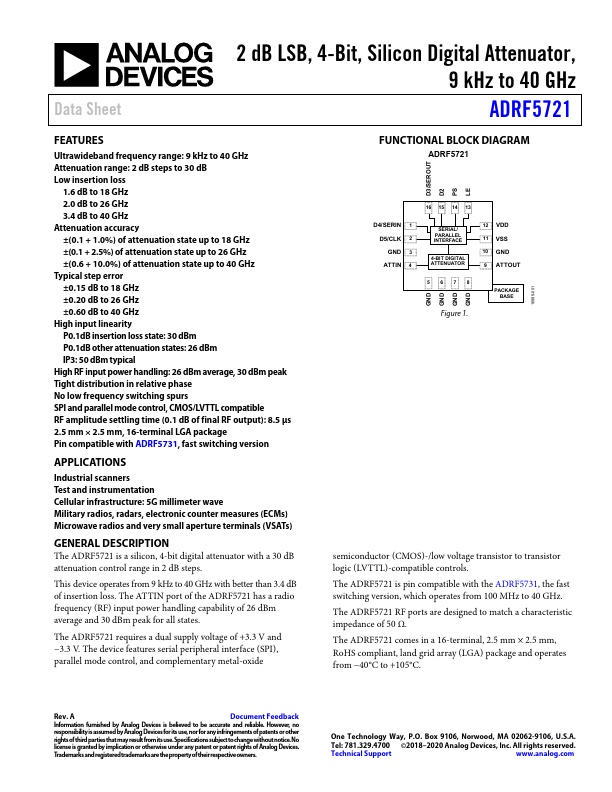
FUNCTIONAL BLOCK DIAGRAM
D3/SEROUT D2 PS LE
16 15 14 13
D4/SERIN 1 D5/CLK 2 GND 3 ATTIN 4
SERIAL/ PARALLEL INTERFACE 4-BIT DIGITAL ATTENUATOR
12 VDD 11 VSS 10 GND 9 ATTOUT
PACKAGE BASE
Figure 1.
GND GND GND GND
16999-001 semiconductor (CMOS)-/low voltage transistor to transistor...