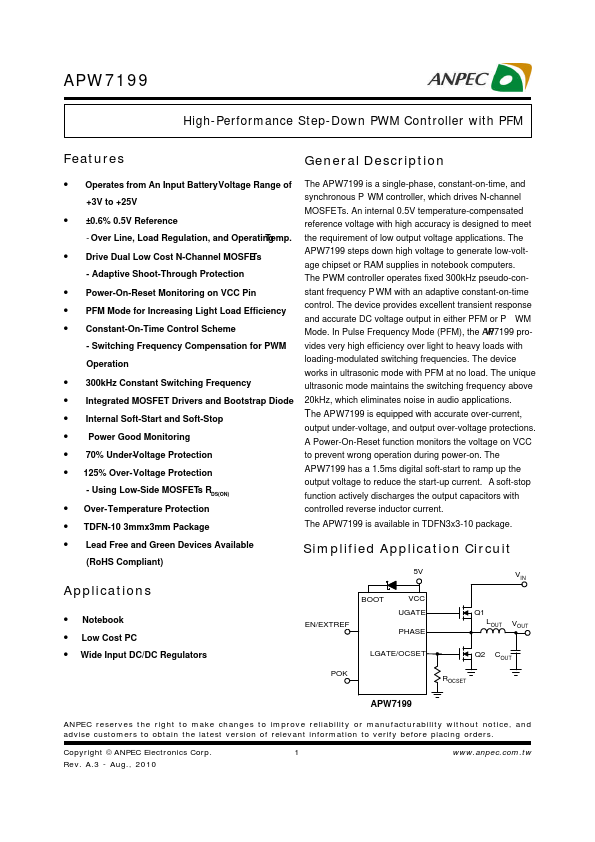
APW7199
APW7199 is High-Performance Step-Down PWM Controller manufactured by Anpec Electronics Coropration.
Features
- -
- -
- -
Operates from An Input Battery Voltage Range of +3V to +25V ±0.6% 0.5V Reference
- Over Line, Load Regulation, and Operating Temp. Drive Dual Low Cost N-Channel MOSFE Ts
- Adaptive Shoot-Through Protection Power-On-Reset Monitoring on VCC Pin PFM Mode for Increasing Light Load Efficiency Constant-On-Time Control Scheme
- Switching Frequency pensation for PWM Operation
General Description
The APW7199 is a single-phase, constant-on-time, and synchronous P WM controller, which drives N-channel MOSFETs. An internal 0.5V temperature-pensated reference voltage with high accuracy is designed to meet the requirement of low output voltage applications. The APW7199 steps down high voltage to generate low-voltage chipset or RAM supplies in notebook puters. The PWM controller operates fixed 300k Hz pseudo-constant frequency P WM with an adaptive constant-on-time control. The device provides excellent transient response and accurate DC voltage output in either PFM or P WM Mode. In Pulse Frequency Mode (PFM), the AP W7199 provides very high efficiency over light to heavy loads with loading-modulated switching frequencies. The device works in ultrasonic mode with PFM at no load. The unique ultrasonic mode maintains the switching frequency above 20k Hz, which eliminates noise in audio applications.
- -
- -
- -
- -
- 300k Hz Constant Switching Frequency Integrated MOSFET Drivers and Bootstrap Diode Internal Soft-Start and Soft-Stop Power Good Monitoring 70% Under Voltage Protection 125% Over-Voltage Protection
- Using Low-Side MOSFET ’ s RDS(ON) Over-Temperature Protection TDFN-10 3mmx3mm Package Lead Free and Green Devices Available (Ro HS pliant)
The APW7199 is equipped with accurate over-current, output under-voltage, and output over-voltage protections. A Power-On-Reset function monitors the voltage on VCC to prevent wrong operation during power-on. The APW7199 has a 1.5ms digital soft-start to ramp up the output voltage to reduce the start-up current. A...