Datasheet4U Logo Datasheet4U.com

CY7C1314KV18 - 18-Mbit QDR II SRAM Two-Word Burst Architecture

Download the CY7C1314KV18 datasheet PDF. This datasheet also covers the CY7C1312KV18 variant, as both devices belong to the same 18-mbit qdr ii sram two-word burst architecture family and are provided as variant models within a single manufacturer datasheet.

Description

The CY7C1312KV18, and CY7C1314KV18 are 1.8 V Synchronous Pipelined SRAMs, equipped with QDR II architecture.

QDR II architecture consists of two separate ports: the read port and the write port to access the memory array.

Features

  • Separate independent read and write data ports.
  • Supports concurrent transactions.
  • 333 MHz clock for high bandwidth.
  • Two-word burst on all accesses.
  • Double-data rate (DDR) interfaces on both read and write ports (data transferred at 666 MHz) at 333 MHz.
  • Two input clocks (K and K) for precise DDR timing.
  • SRAM uses rising edges only.
  • Two input clocks for output data (C and C) to minimize clock skew and flight time mismatches.
  • Echo clocks (CQ and CQ) sim.

📥 Download Datasheet

Note: The manufacturer provides a single datasheet file (CY7C1312KV18-CypressSemiconductor.pdf) that lists specifications for multiple related part numbers.

Full PDF Text Transcription (Reference)

The following content is an automatically extracted verbatim text from the original manufacturer datasheet and is provided for reference purposes only.

View original datasheet text
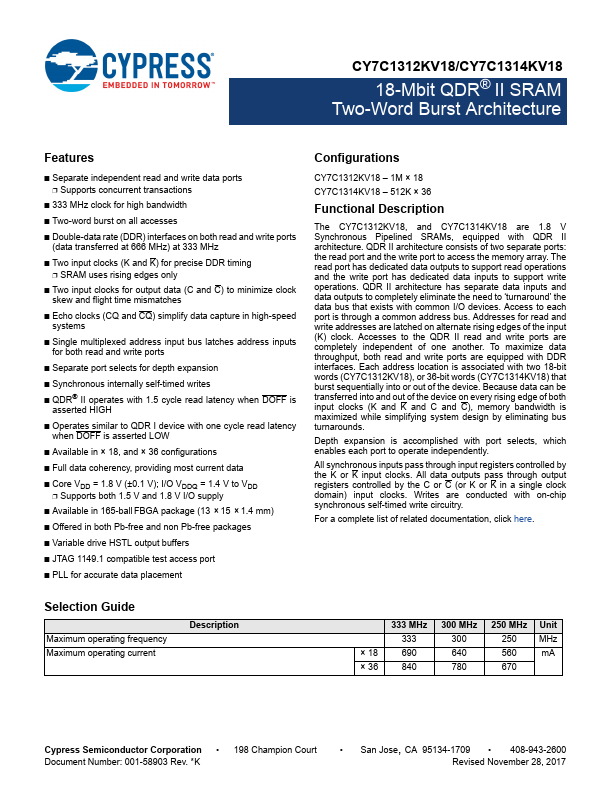
CY7C1312KV18/CY7C1314KV18 18-Mbit QDR® II SRAM Two-Word Burst Architecture 18-Mbit QDR® II SRAM Two-Word Burst Architecture Features ■ Separate independent read and write data ports ❐ Supports concurrent transactions ■ 333 MHz clock for high bandwidth ■ Two-word burst on all accesses ■ Double-data rate (DDR) interfaces on both read and write ports (data transferred at 666 MHz) at 333 MHz ■ Two input clocks (K and K) for precise DDR timing ❐ SRAM uses rising edges only ■ Two input clocks for output data (C and C) to minimize clock skew and flight time mismatches ■ Echo clocks (CQ and CQ) simplify data capture in high-speed systems ■ Single multiplexed address input bus latches address inputs for both read and write ports ■ Separate port selects for depth expansion ■ Synchronous internally
Published: |