Datasheet4U Logo Datasheet4U.com

CYM1481 - (CYM1471 / CYM1481) 2048k X 8 SRAM Module

This page provides the datasheet information for the CYM1481, a member of the CYM1471 (CYM1471 / CYM1481) 2048k X 8 SRAM Module family.

Datasheet Summary

Description

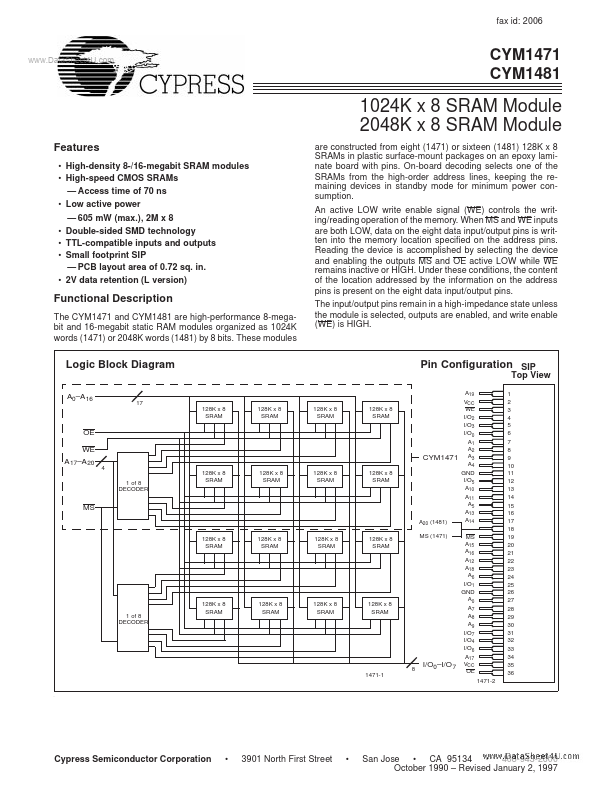
The CYM1471 and CYM1481 are high-performance 8-megabit and 16-megabit static RAM modules organized as 1024K words (1471) or 2048K words (1481) by 8 bits.

A 16 Pin Configuration SIP A19 VCC WE I/O2 I/O3 I/O0 A1 A2 A3 A4 GND I/O5 A10 A11 A5 A13 A14 1 2 3

Features

  • High-density 8-/16-megabit SRAM modules.
  • High-speed CMOS SRAMs.
  • Access time of 70 ns.
  • Low active power.
  • 605 mW (max. ), 2M x 8.
  • Double-sided SMD technology.
  • TTL-compatible inputs and outputs.
  • Small footprint SIP.
  • PCB layout area of 0.72 sq. in.
  • 2V data retention (L version) are constructed from eight (1471) or sixteen (1481) 128K x 8 SRAMs in plastic surface-mount packages on an epoxy laminate board with p.

📥 Download Datasheet

Datasheet preview – CYM1481

Datasheet Details

Part number CYM1481
Manufacturer Cypress Semiconductor
File Size 190.02 KB
Description (CYM1471 / CYM1481) 2048k X 8 SRAM Module
Datasheet download datasheet CYM1481 Datasheet
Additional preview pages of the CYM1481 datasheet.
Other Datasheets by Cypress Semiconductor

Full PDF Text Transcription

Click to expand full text
1CY M14 81 fax id: 2006 www.DataSheet4U.com CYM1471 CYM1481 1024K x 8 SRAM Module 2048K x 8 SRAM Module Features • High-density 8-/16-megabit SRAM modules • High-speed CMOS SRAMs — Access time of 70 ns • Low active power — 605 mW (max.), 2M x 8 • Double-sided SMD technology • TTL-compatible inputs and outputs • Small footprint SIP — PCB layout area of 0.72 sq. in. • 2V data retention (L version) are constructed from eight (1471) or sixteen (1481) 128K x 8 SRAMs in plastic surface-mount packages on an epoxy laminate board with pins. On-board decoding selects one of the SRAMs from the high-order address lines, keeping the remaining devices in standby mode for minimum power consumption. An active LOW write enable signal (WE) controls the writing/reading operation of the memory.
Published: |